As the state coordinator for Bird City Maryland, I was part of an international delegation to Colombia in South America this past fall. The trip took place over 10 days in mid-October, in the middle of fall migration, and coincided with World Migratory Bird Day. One of the main requirements to become and sustain the designation as a Bird City is to celebrate World Migratory Bird Day with an event in your community.
I travelled to Colombia to learn about Bird City Colombia, established in 2023 and the first South American country with a Bird City program. Our intent was to participate in their World Migratory Bird Day celebrations and see what types of actions they were doing in the four Bird City categories: habitat, threats to birds, education and engagement, and sustainability. The idea was that we could bring ideas back to our states and our communities and inspire and strengthen our program by seeing what communities were doing in Colombia. We also met with local Bird City partners and participated in the ceremony welcoming 10 new Bird Cities into the Bird City Colombia program.
The trip was coordinated by Environment for the Americas for the Bird City Network. The delegation included a state Bird City coordinator, the National Bird City Network coordinator, the Bird City coordinator for Colombia, the Executive Director of the Environment for the Americas and three other people affiliated with Bird City.
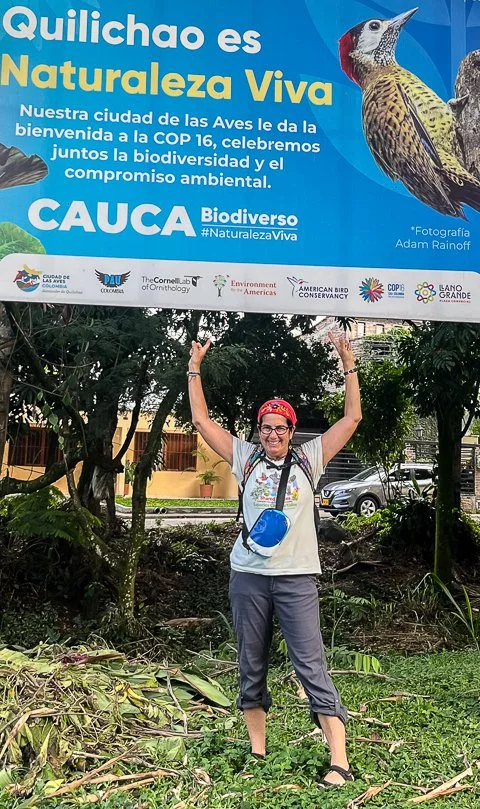
Bird City Maryland coordinator Pamela Kellett points to the logos on a billboard in Cali, Colombia: “Our city of birds welcomes you to COP 16; let's celebrate biodiversity and environmental commitment together.” The logos include Bird City sponsors American Bird Conservancy and Environment for the Americas.

If you’re inspired by Pamela’s story to get involved in Bird City Maryland, you can read more about it here.
Watch the Magic!
Magical Cities / Magical Experiences
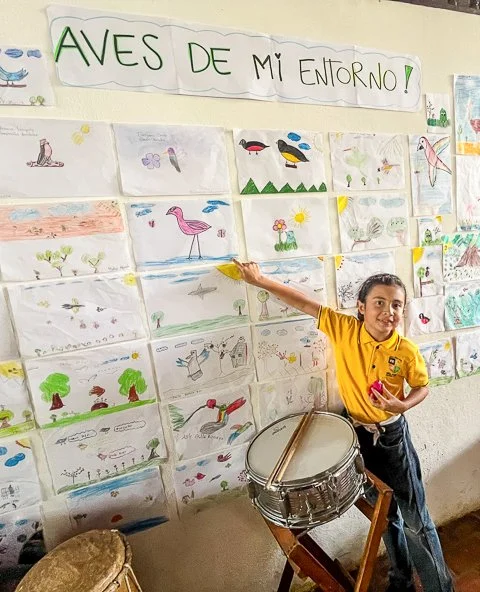
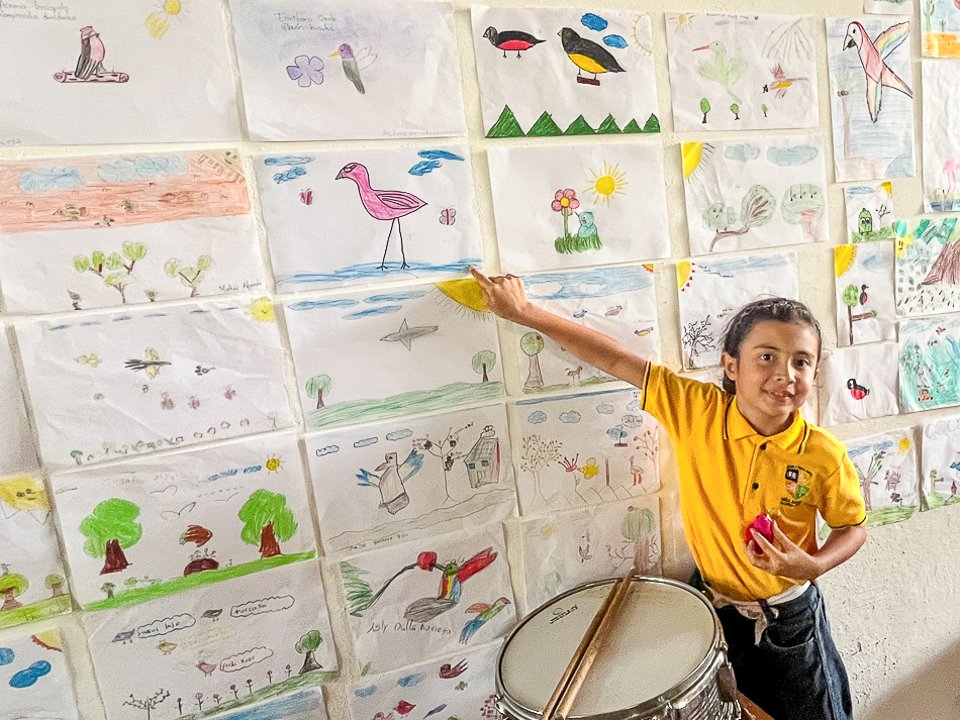
Maria Celeste, a student at Escuela Nina Maria de Japio outside of Santander de Quilichao, points to the drawing she made of her favorite ave de mi entorno - “bird in my environment.”
Immersed in the home country of Gabriel Garcia Marquez—a writer famous for popularizing a literary style known as magical realism—the trip was one magical experience after another. We visited four communities in the state of Valle de Cauca: Santander de Quilichao, Palmira, Caloto and Calima, and finally the state capital, Cali.
One day we drove down a dirt road for an hour, and when we got out of the van after the dusty ride, there was an 11-piece high school band playing classical guitar for us. We also went to the kite surfing capital of the world high up on a lake in the Andes mountains. We never knew what magic would be waiting for us at the end of the road.
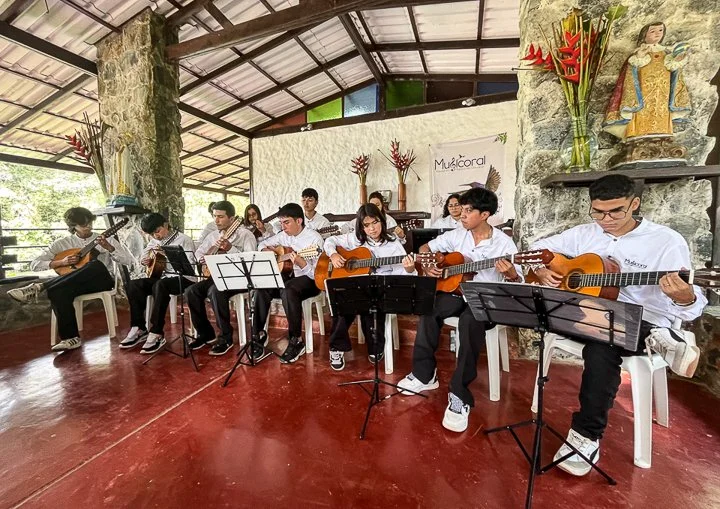
An 11-piece high school student band greeting the delegation in a town applying to be a bird city. The students performed Andean folk music on the classical guitar and the traditional, pear-shaped 16-string guitar called bandola de Colombia.
Colombia has 20% of the world’s bird species (around 1,900-2,000 species) including 200 migratory species, 87 threatened birds, and 78 endemics: the most bird diversity of any country in the world. Unsurprisingly, with its colorful toucans and macaws and tanagers, it is the top destination for birdwatchers.
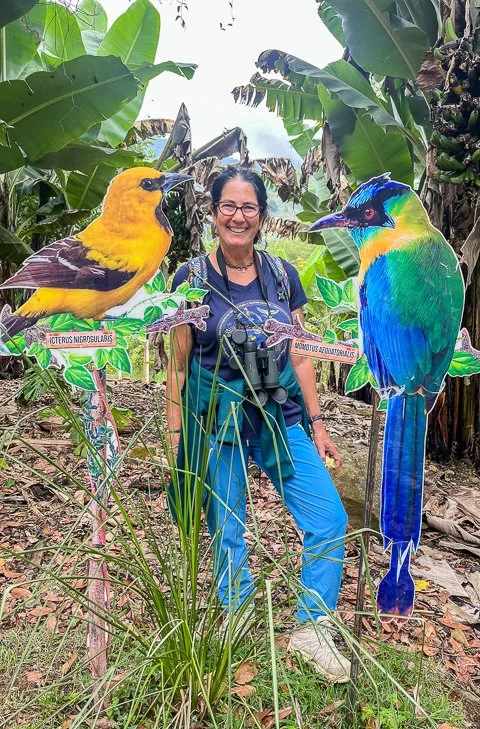
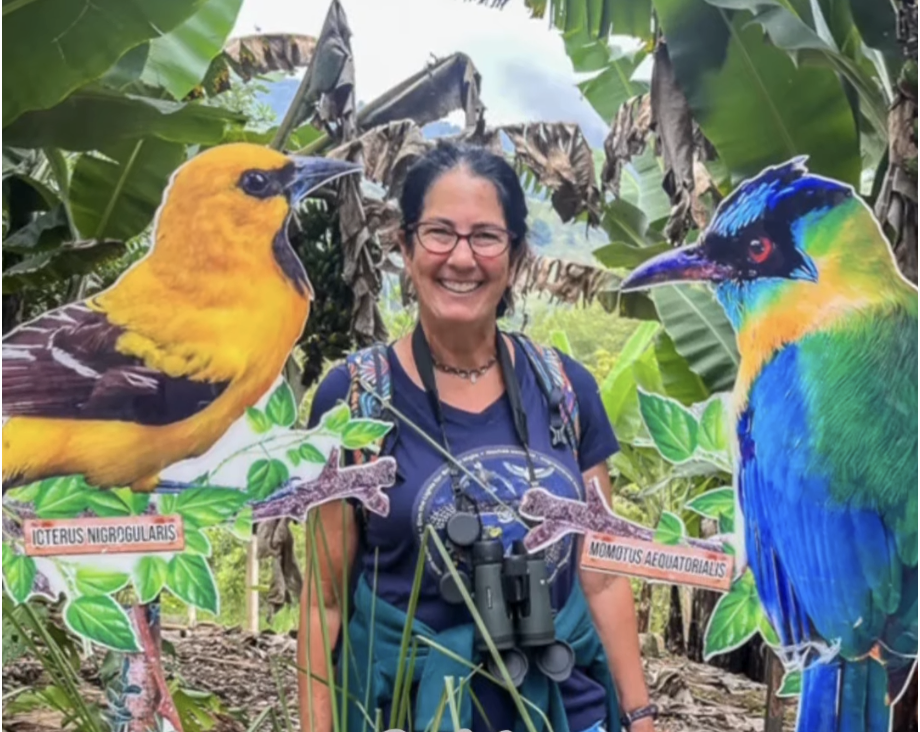
Bird City Maryland coordinator Pamela Kellett poses with cutout posters of a Yellow Oriole (Icterus nigrogularis)and Andean Motmot (Momotus aequatorialis) at the reserve outside Santander de Quilichao.
We went birding every day, either in the town parks or in adjacent reserves. Our eBird list had 173 species. The bird I wanted to see the most was the Common Potoo, an endearing looking bird in the nightjar family. In Spanish the bird’s name is Bien Parada (which means “Well Stopped”). I speak Spanish, and I love that name so much. In the Yotoco municipality we took a boat trip and saw Common Potoos that our birding guide pointed out along the riverbanks. With their camouflaged brown and cream coloring and propensity to perch absolutely still on broken off tree trunks they were incredibly difficult to spot. I was thrilled to spy one on my own in Cali’s botanical gardens on our last day.
Colombians know that they are living in a country that has incredible avian biodiversity and multiple endemic species. I was immediately struck by how excited the communities were to be recognized as Bird City communities. There is Bird City signage and bird murals all over the towns. In Santander de Quilichao, Colombia’s first Bird City, the Ciudad de las Aves logo is even on the garbage trucks.
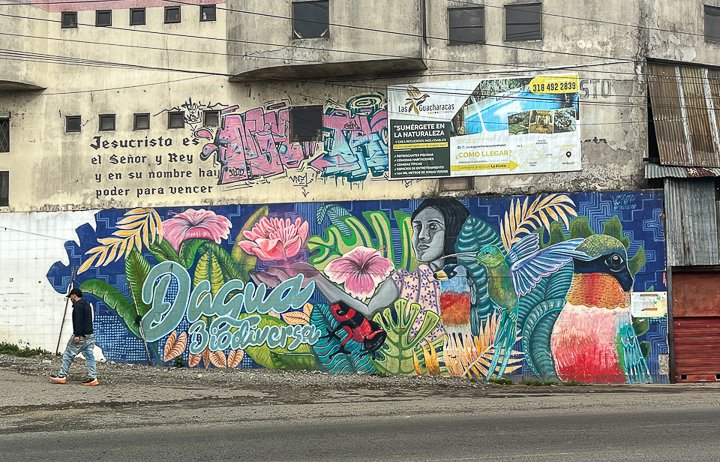
A public mural celebrating biodiversity and birds, on the outskirts of the city of Cali.
Celebrating World Migratory Bird Day
Santander de Quilichao was the first Bird City in Colombia and we spent most of our visit there. First on our agenda was a visit to the mayor’s office. Everyone in the meeting was wearing a shirt with a Bird City (Ciudad de las Aves) logo and we were warmly welcomed with Colombian coffee.
Santander de Quilichao is not a city with colonial architecture. With only one hotel it is not a tourist destination. It feels more like the town where you go to visit your grandma. But the whole city is covered with murals, and they are all bird murals. They hope that avitourism will become a draw for tourism in the region.
The town held an absolutely spectacular World Migratory Bird Day parade. Each school chose a bird that is found locally and spent two months creating their costumes. Students dressed up as birds and there were giant puppets and accompanying marching bands. It was like nothing I had ever seen in the United States.
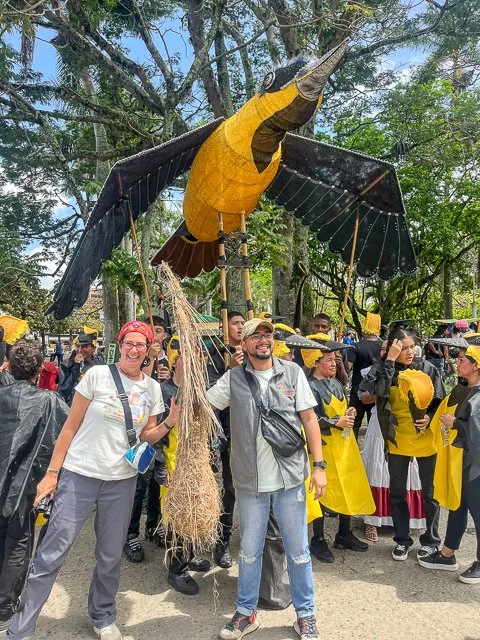
Bird City Maryland coordinator Pamela Kellett and Bird City Colombia coordinator Miguel Matta, who is from Venezuela, pose with a giant puppet of a Yellow Oriole. The Yellow Oriole is the Bird City signature bird of Santander de Quilichao.
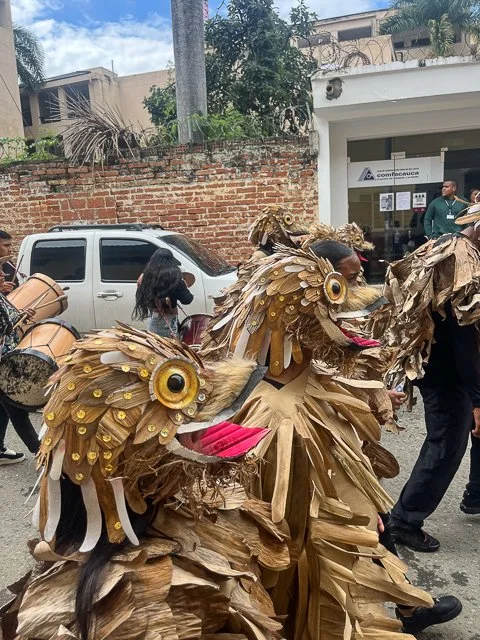
Students in Common Potoo costumes enliven the World Migratory Bird Day parade in Santander de Quilichao.
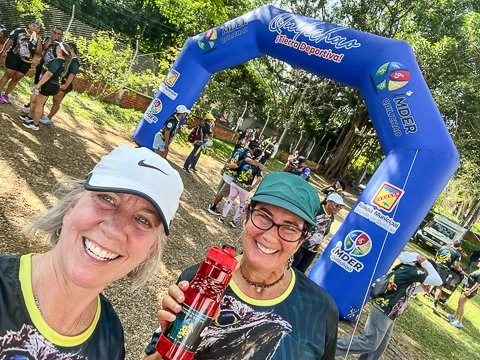
Joanna Eckles, who oversees the Bird City Network in the United States for the American Bird Conservancy, and Bird City Maryland coordinator Pamela Kellett, sporting their Common Potoo t-shirts and Ciudad de las Aves water bottles, after completing the 7K run in Santander de Quilichao.
The next day we participated in their second annual bird city 7K run (there were 1K and 3K walks too). They gave us shirts with a Common Potoo on them! We ran the race and then they held a community event about being a Bird City. Team USA did not perform well and could barely salsa dance at the after-party.
On the third day we went to their local reserve where they are doing habitat work, particularly focused on bird species. They held a bird walk, followed by a breakfast, and the Mayor provided a local open-air bus so that townspeople would have access to join us in the reserve. There was local press on the bird walk and I had the opportunity to talk about Bird City Maryland in my somewhat proficient Spanish.
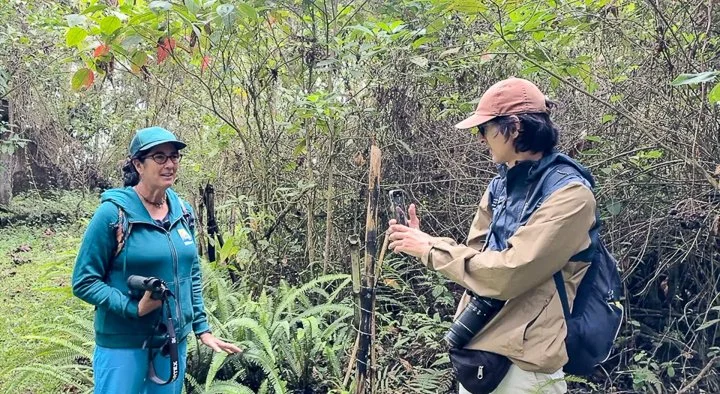
Bird City Maryland coordinator Pamela Kellett gives a press interview in Spanish, as part of the World Migratory Bird Day events.
Our team met with a group of teachers, many of whom had participated in the Bird Parade/Carnival, and they shared their avian themed curriculum. For 10 years, I taught a Pre-K class called the Feathered Friends, and I was excited to share both my classroom experience as well as my Bird City experience with them.
We visited a private elementary school, Escuela Nina Maria de Japio, which is located on the grounds of a former hacienda base of Simon Bolivar, an important historical figure in the fight for independence from the Spanish Empire. The students dressed up as birds and performed a musical play and shared their bird art.
As mentioned earlier, a Bird City action requirement is to celebrate World Migratory Bird Day, but there is no prescription on how it is to be celebrated. There is a lot of creativity in the program, and every community celebrates differently. The Environment for the Americas provides an annual conservation action theme as well as extensive educational and celebration resources around the theme. The 2025 theme was “Shared Spaces: Creating Bird Friendly Communities.” It was really inspiring to see all the actions that have been completed in Santander de Quilichao. In another town, Palmira, their World Migratory Bird Day celebration was in the central park and they had scientists talking about avian conservation followed by a bird walk.
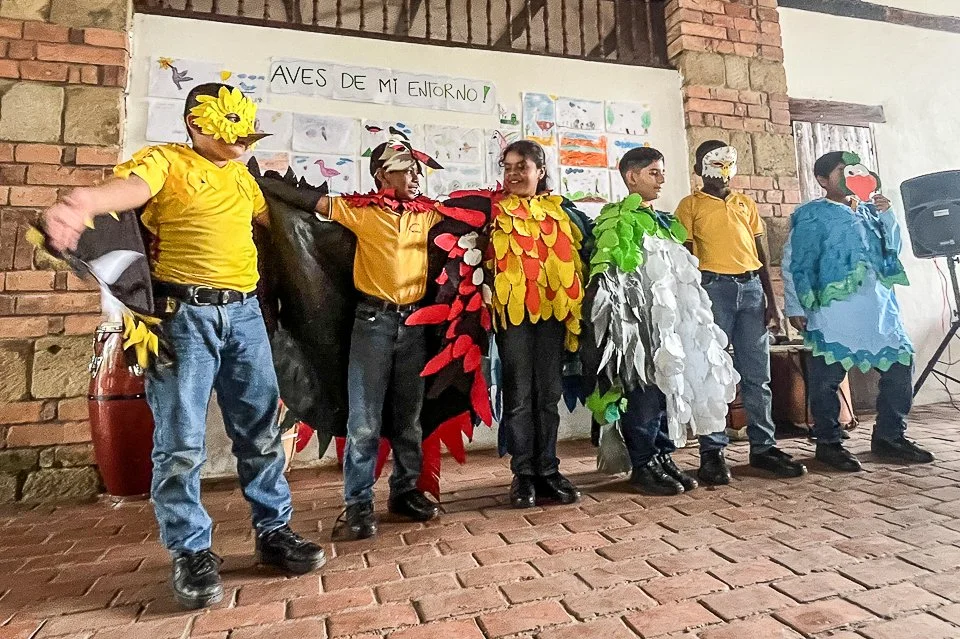
Students at Escuela Nina Maria de Japio, outside of Santander de Quilichao, greeted the delegation wearing their colorful bird masks and costumes.
Expanding Bird City Throughout the Americas
The Bird City Colombia program has been in existence for two years, and it was the first Latin American country that had a Bird City. Bird City Mexico (with two current cities) and Bird City Brazil also have programs, and a Bird City Caribbean expansion is in the works.
Our trip ended in Cali, the state capital and a city of 2.5 million people. We participated in the initial application and renewal ceremonies for the new and existing Bird Cities in Columbia, which were held in the Governor’s offices. Each of the Bird City representatives gave five-minute presentations. When we arrived in Colombia there were two Bird Cities, and by the time we left there were twelve Bird Cities!
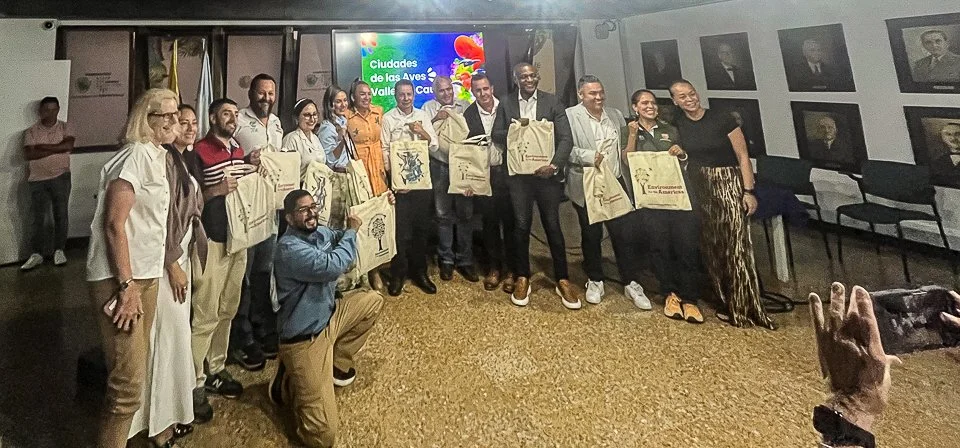
Representatives from the renewed and newly certified Bird Cities pose with Miguel Matta, the Bird City Columbia coordinator (in front). They are holding “happy kits” containing materials-- bird masks, stickers, posters, “Amigo de las Aves” bird buddy bracelets, and other items--that they can use in their community to celebrate World Migratory Bird Day.
Final Thoughts
It was so exciting to be a participant on the trip and was tremendously meaningful for me both personally and professionally. Part of the magic was that everyone was so glad that we were able to come and share and celebrate with them. I was inspired by the fact that in Colombia the Bird Cities know each other. It sparked the idea to host the first virtual Happy Hour for all the Bird Cities in Maryland. It will be on February 3rd at 4 pm and participants will be able to meet each other, to meet MBCP director Gabriel Foley, learn about Bird City Colombia and to share actions they’ve done as a Bird City which I know will inspire even more creative bird conservation actions across the state of Maryland.