
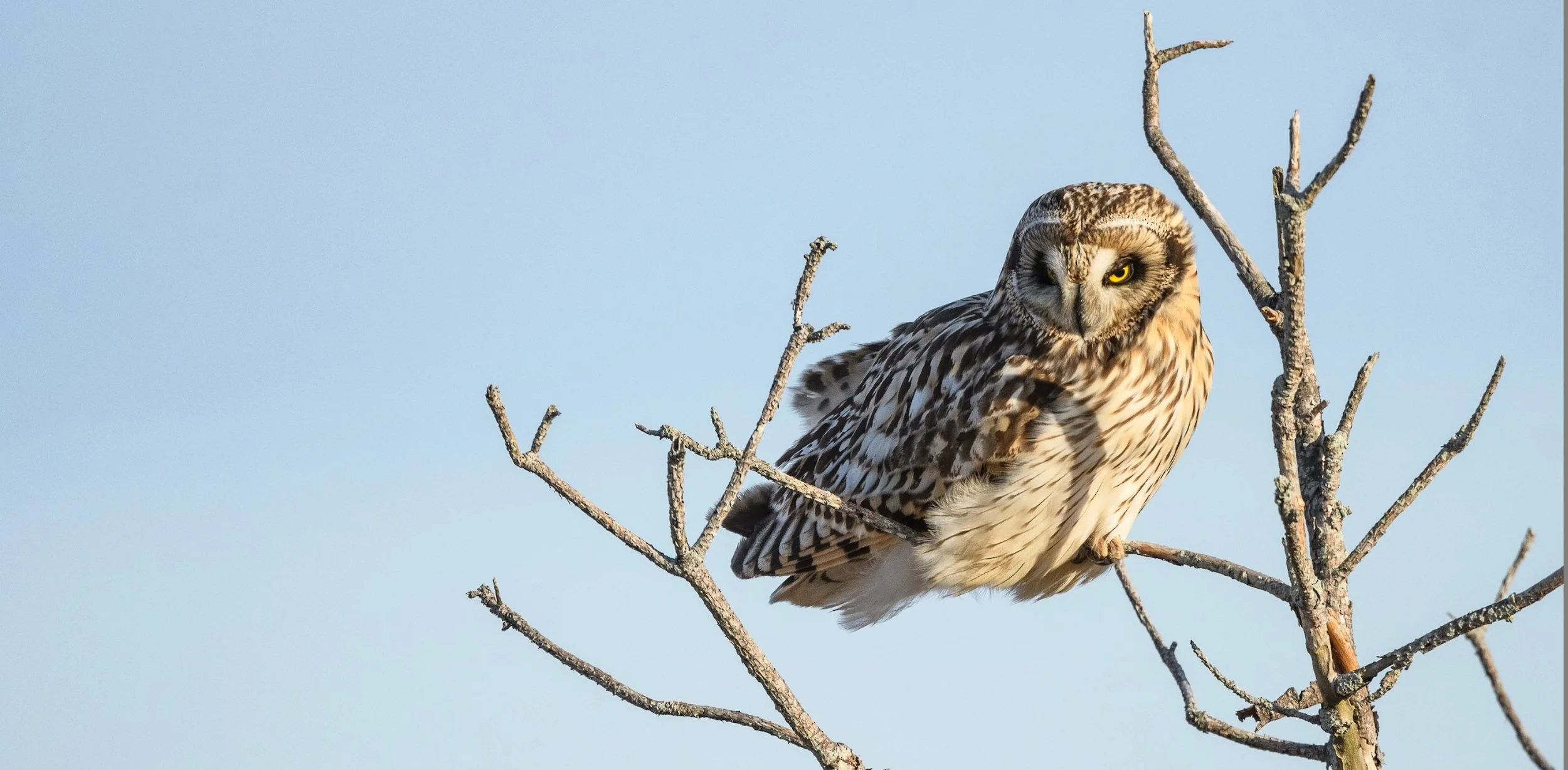
From First Capture to the First Transmitter Fund
If you’ve ever been on a Short-eared Owl tour at Konterra with Jay Sheppard, you’ve probably heard his impression of a squeaking vole.
By December 6, 2024, Jay had spent multiple nights trying to convince Farmland Raptor Program Manager Andy Brown and me that if we just let him lie underneath one of our mist nets and do that impression, we would catch a Short-eared Owl.
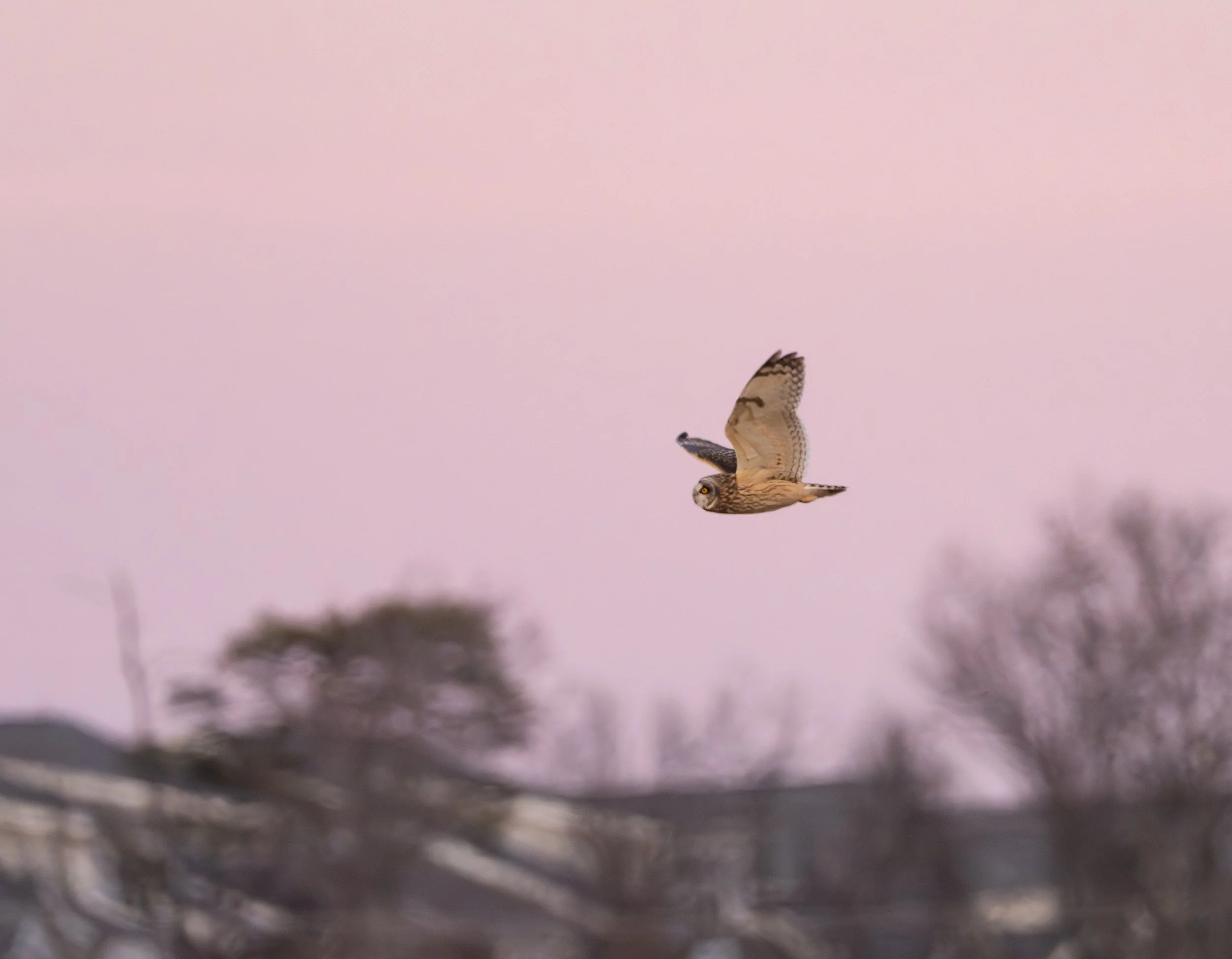
A Short-eared Owl flies over Konterra. Photo by Lawrence Rhoads.
Of course, I thought this was a crazy idea. Not because I doubted Jay’s commitment to the bit, but because we were trying to develop a method that could be repeated at other sites without needing Jay tucked under a mist net doing his best vole impression.
So we told him no.
But later that night, Jay made his way under the net and did it anyway.
And to our surprise ... we caught our first Short-eared Owl.
That bird, later named Konnie, became the first adult Short-eared Owl banded in Maryland in nearly 50 years. Only one had ever been banded in the state before her, on January 5, 1975.
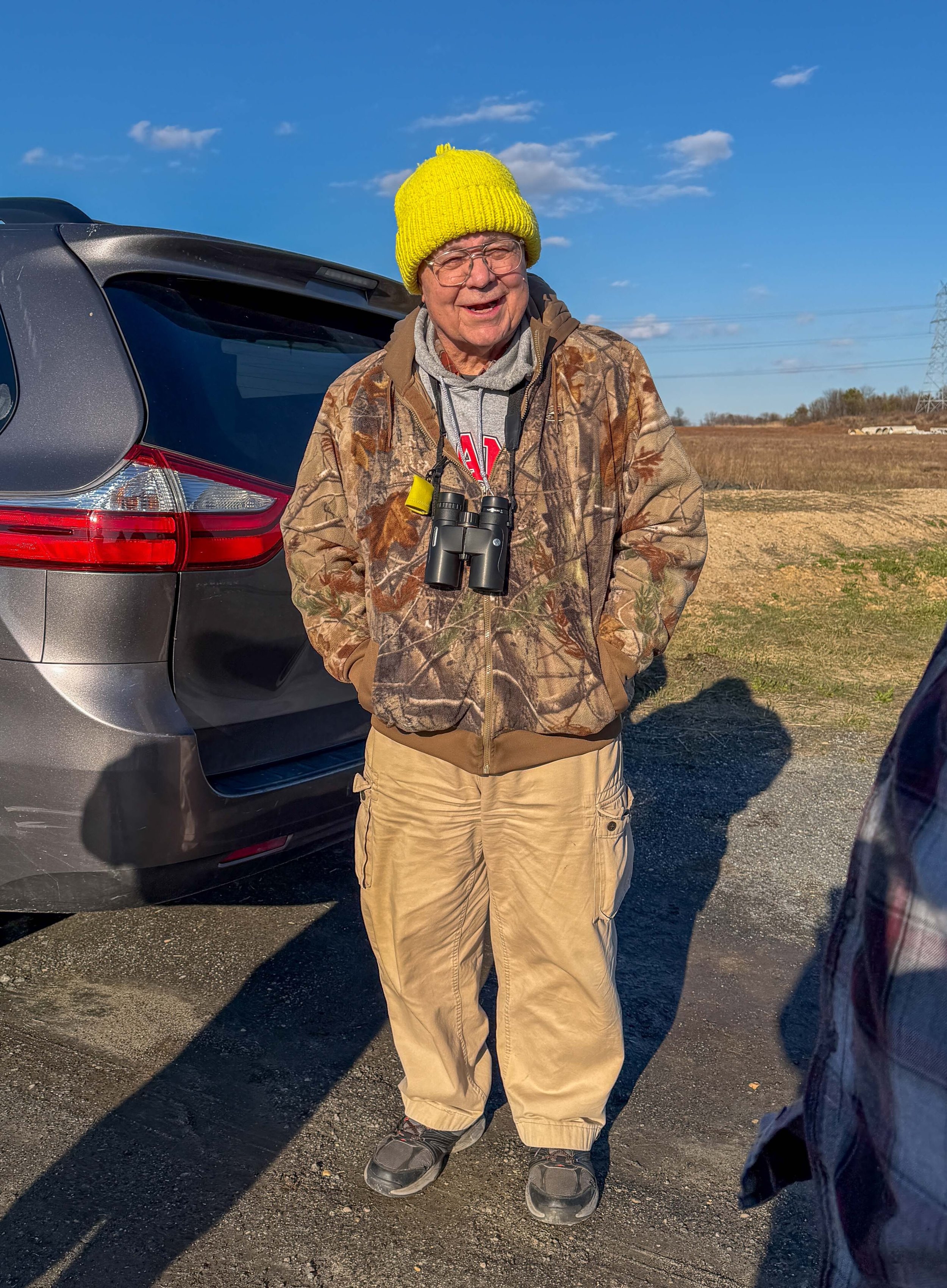
Jay Sheppard at Konterra, where he has led Short-eared Owl tours for the past decade. Photo by Margaret Poethig.
Her name was a nod to Konterra, an almost 400-acre grassland tucked beside the interchange of I-95 and MD 200 where she was captured. Surrounded by urban development, Konterra is an unlikely pocket of prime habitat that annually supports wintering Short-eared Owls and many other grassland bird species. Jay, a retired U.S. Fish and Wildlife Service biologist, has spent the past decade leading Short-eared Owl tours at this otherwise private property. Those tours have helped make Konterra one of the most accessible places in Maryland to experience these birds.
Konnie’s capture was historic, but it was only the beginning. Developing a safe, repeatable capture method would open the door to work on taxonomy, aging, health, and movement.
One owl certainly did not mean we had a fully replicable method, but it gave us something we had been chasing: hope that this could actually be done.

A view across the grasslands at Konterra. Photo by Lawrence Rhoads.
Where the Project Began
It all started for me in September 2023, more than a year before we caught Konnie. Andy texted me to let me know that the Southern Maryland Audubon Society had approved funding for me to attend the World Owl Conference in Onalaska, Wisconsin. Little did they know that their support would spark a full-blown, species-specific obsession.
Before I knew it, Andy and I were at the conference representing the Farmland Raptor Program of the Maryland Bird Conservation Partnership (MBCP). We were surrounded by owl nerds, hooting competitions, and experts from around the world.
At that point, I had only ever seen one Short-eared Owl. It was tucked under a bush about a quarter mile away at Masonville Cove in Baltimore City, sitting like a statue and barely visible through the heat shimmer. It was an underwhelming first encounter, but it had left me curious.
The World Owl Conference gave that curiosity somewhere to go. Because Short-eared Owls are among the Farmland Raptor Program’s focal species, one recurring theme at the conference caught our attention: how much remains unknown about the movements of a species that occurs on five of seven continents and attracts considerable attention from birders and photographers worldwide. That raised questions closer to home. Where do Maryland’s wintering Short-eared Owls go after they leave us? Do they return to the same places? What other states, regions, or habitats are connected to the birds we see here? We saw an opportunity to contribute to a broader understanding of the species by studying the owls wintering in Maryland.
Conversations around that knowledge gap helped lead to the formation of the Global Short-eared Owl Working Group. For us, they also marked the beginning of a new area of work within MBCP’s Farmland Raptor Program: learning more about the Short-eared Owls that winter in Maryland.
Together, those movement questions led to a larger one: How big is the world of a Short-eared Owl wintering in the East? Answering it would eventually require GPS tracking. First, we had to solve a more immediate challenge: how to capture the owls safely and consistently.
Solving the Capture Problem
We immediately started digging through the literature and talking to anyone we could find who had experience capturing this species.
One of the first papers we found was titled “Use of a Net Gun to Safely Capture Short-eared Owls in Midflight from a Helicopter” by Booms et al. (2012). For more reasons than one, this was obviously out of the question for us.
Our review of the literature made one challenge clear: many published capture methods were designed for conditions that did not exist at our Maryland sites. Several depended on owls being concentrated around a nest or communal roost. Short-eared Owls occur in Maryland primarily during winter and breed in the state only rarely. At our sites, there may be only a few wintering birds ranging across a large open landscape, leaving no predictable location to target. We needed a method that could reliably bring an owl to a safe capture setup. Researchers we contacted told us that finding one would likely require repeated attempts and constant adjustment.
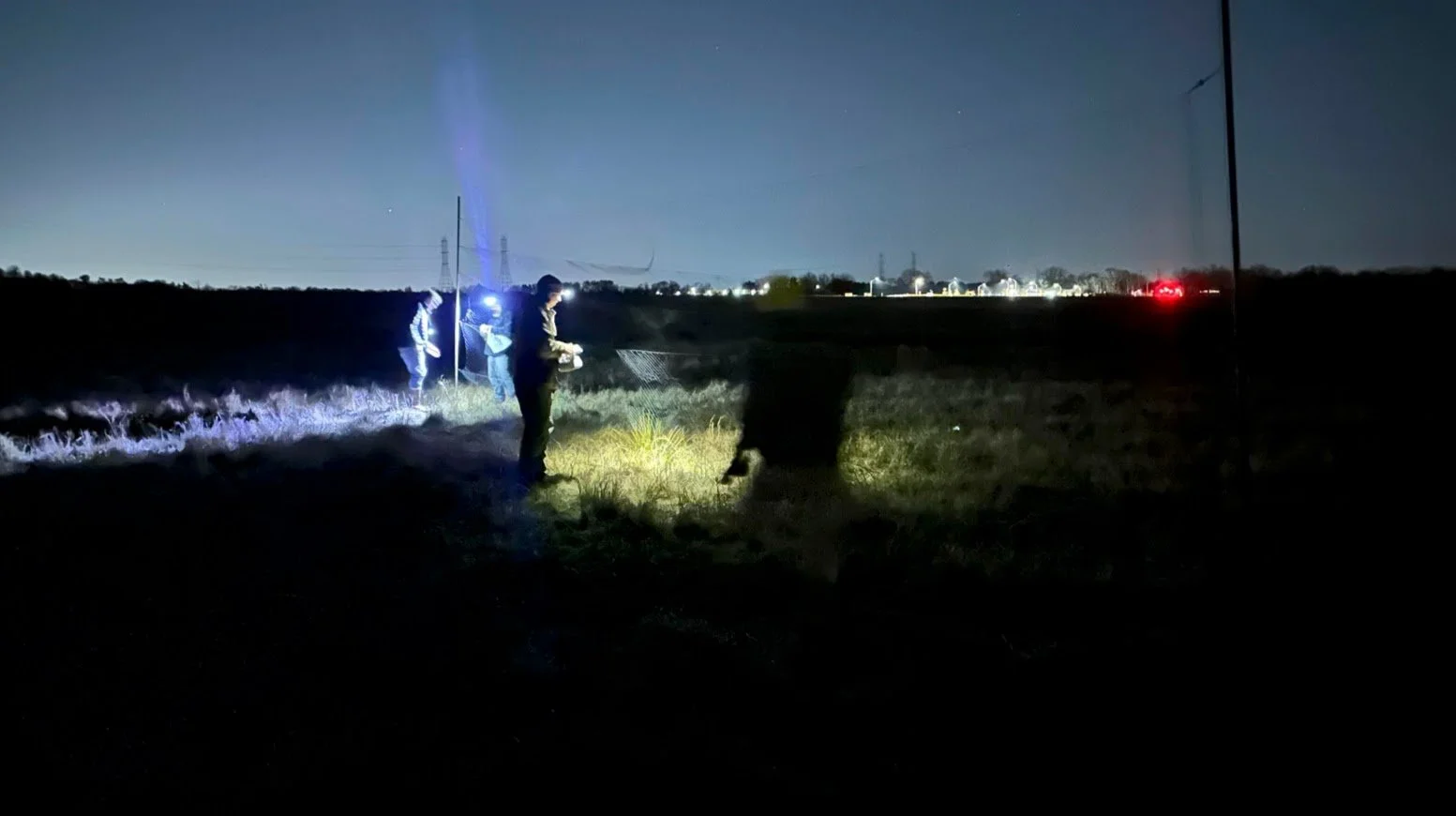
Setting up a mist net during a Short-eared Owl capture attempt at Konterra. Photo by Melissa Boyle-Acuti.
Our first attempt took place at Konterra on February 4, 2024. We tested three methods that researchers around the world had used with varying levels of success and spent five hours hoping we had it right.
We didn’t.
Our window was short. The owls would leave by spring and would not return until November, so every unsuccessful night narrowed our opportunity. We tried again at sites across the state, but the season ended without a capture.
The months without Short-eared Owls gave us time to rethink our approach. When the birds returned that November, so did we. On December 6, we were back at Konterra for the night that opened this story.
Konnie’s capture gave us a starting point. In the winters since, we have adapted what worked at Konterra for other sites across Maryland. We have now banded 11 Short-eared Owls in the state.
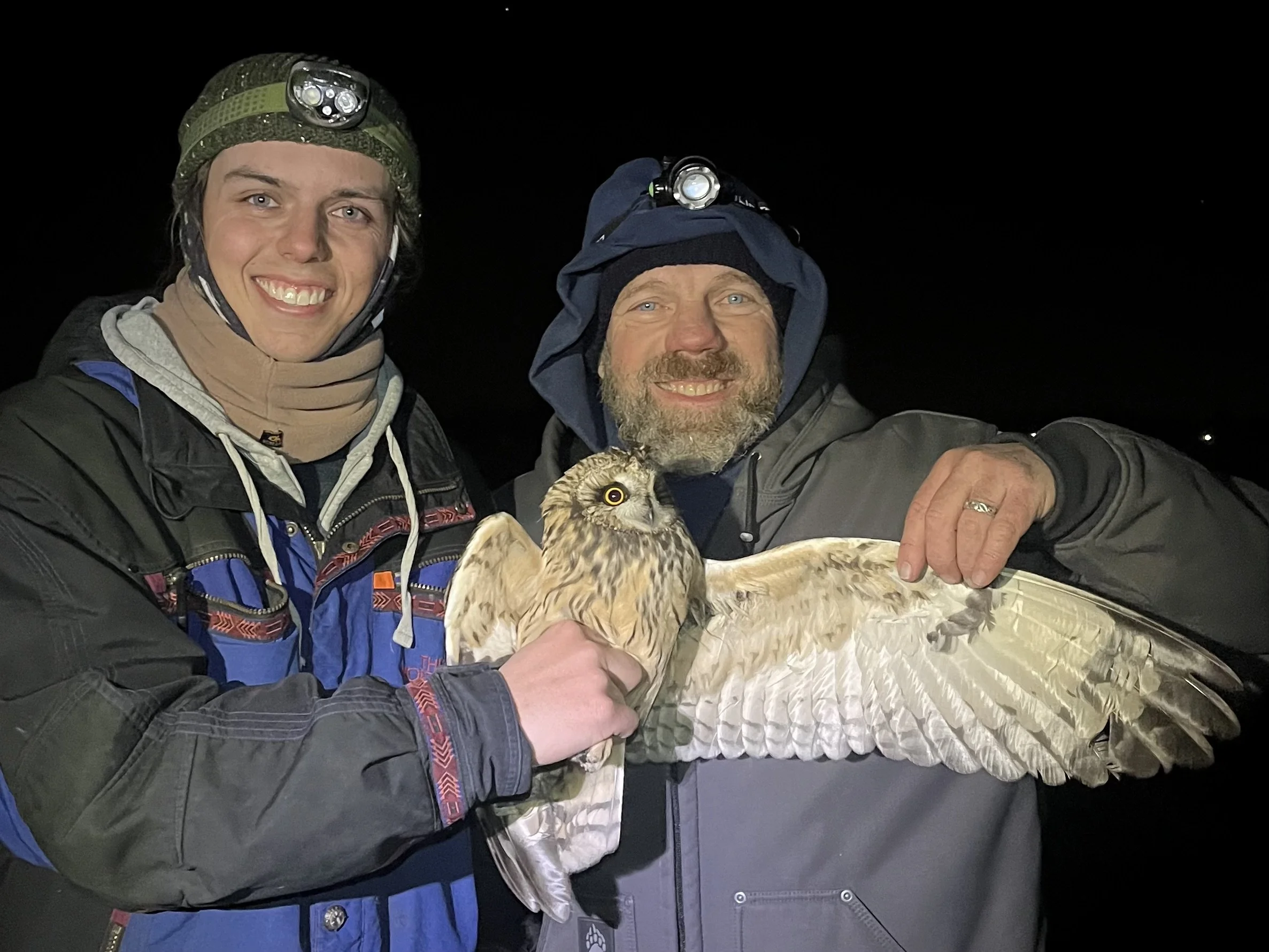
Alex Pellegrini (left) and Andy Brown (right) with Konnie, Maryland’s first adult Short-eared Owl banded in nearly 50 years. Photo courtesy of MBCP.
Watch this video for a closer look at how Alex Pellegrini and Andy Brown developed their Short-eared Owl capture methods.
What Each Owl Can Tell Us
An owl in hand gives us more than a chance to place a band. During the brief time we have with each owl before releasing it, we collect measurements, photographs, and biological samples that contribute to broader work on taxonomy, aging, and health. Together, they help build the knowledge needed to conserve a species we still understand surprisingly little about.
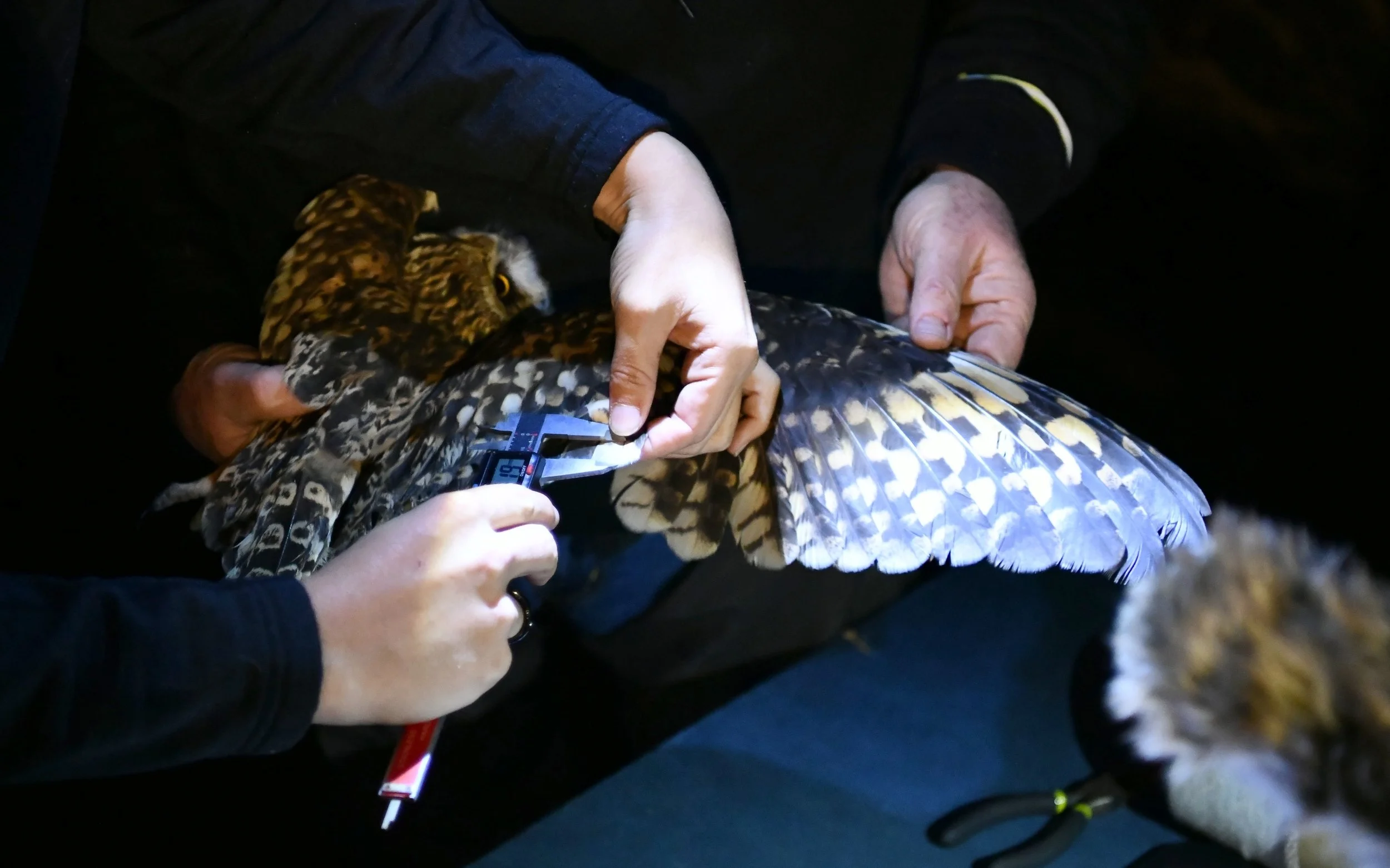
Alex Pellegrini takes measurements from a Short-eared Owl before its release. Photo by Michelle Huston.
Each owl also receives a uniquely numbered leg band. If it is ever encountered again, that band can connect two points in its life. Johnson et al. (2017) reported that of 3,200 Short-eared Owls banded in North America since 1922, only 15 were recovered more than 100 km from their banding sites. Such long-distance recoveries are exceptionally rare. Even when one occurs, it provides only a second location, leaving the journey between the two points largely invisible.
Following a Moving Target
Short-eared Owls are feathered prospectors looking for gold, and for them, gold is a field full of voles. These small rodents are the owls’ primary prey, but vole populations boom and bust unpredictably across the landscape. Rather than following the relatively predictable seasonal movements we associate with many migratory birds, the owls roam widely in search of places where food is plentiful. They may travel thousands of miles, appearing in an area one year and vanishing the next.
So how do you track the movements of a ghost?
Unlike a leg band, a GPS transmitter can provide movement data even if the owl is never encountered again. These small, lightweight tracking devices are fitted to an owl’s back using a harness and record locations as the bird moves. They can reveal the route an owl took, how long it stayed in different places, and which habitats it used along the way.
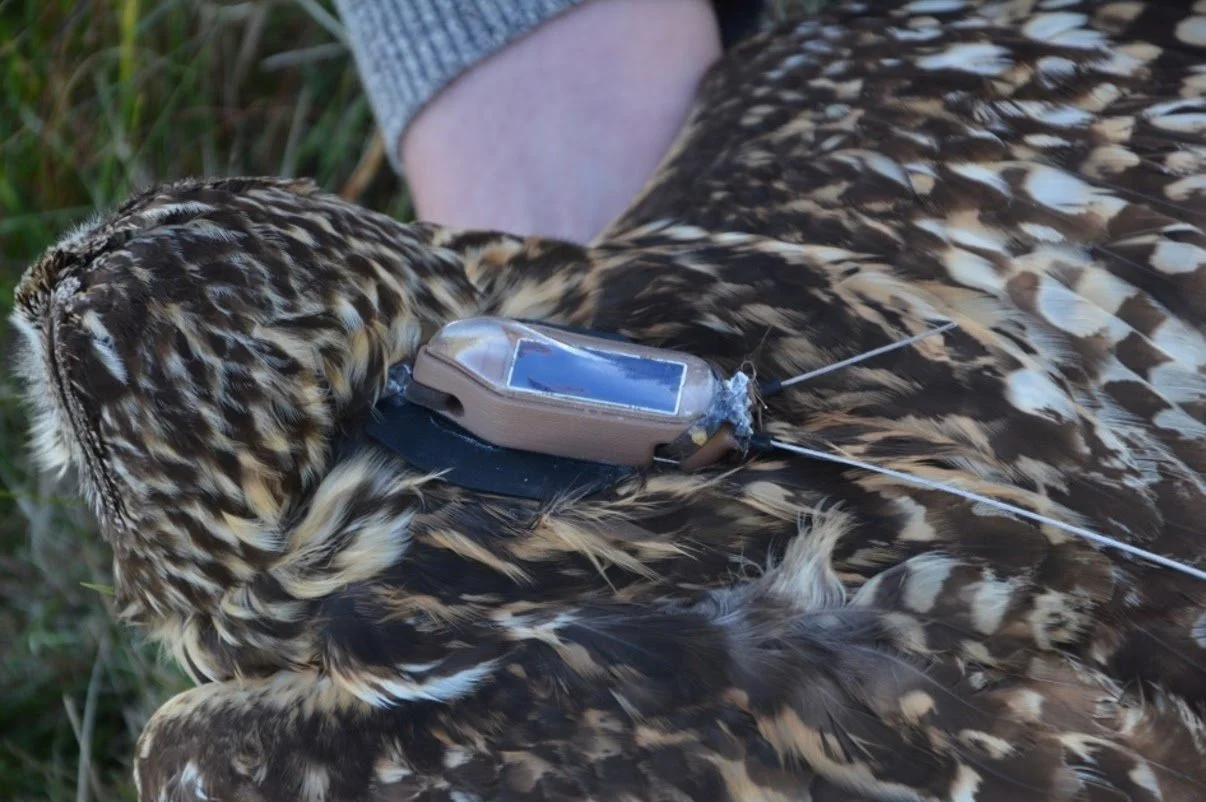
A Short-eared Owl fitted with a GPS transmitter during tracking work led by John Calladine and colleagues. Photo by John Calladine.
That matters because the owls that winter in Maryland may depend on habitats hundreds or thousands of miles away. Without understanding those connections, we are trying to conserve them while seeing only a small part of their lives.
Studies elsewhere show just how much this technology can reveal. Calladine et al. (2024) tracked one owl whose nest sites in consecutive years were 4,216 km (2,620 miles) apart. That is like building your house in New York one year and then in Los Angeles the next year, purely because the grocery store there had better snacks. Another female bred in Scotland, flew 926 km (575 miles) to Norway, and bred again within the same season.
The researchers also estimated an average annual survival rate of 47% for adult Short-eared Owls. In a blog post, John Calladine described these birds as living the “hedonistic lifestyle of a 1970s rockstar” as they “travel wide, breed hard and die young.” The line is dramatic, but it captures what makes these birds both fascinating and extraordinarily difficult to conserve.
In North America, Johnson et al. (2017) documented southbound movements of up to 6,886 km (4,278 miles) by Short-eared Owls breeding in Alaska, showing that these birds can move across huge portions of the continent.
Tracking studies have revealed extraordinary movements, but they have also shown how much of the map remains blank. For a species found across five continents, tracking data remain sparse in many regions, including eastern North America. We still know little about where birds wintering in Maryland travel or which landscapes are connected through their movements.
Connecting the Dots
Conserving a species this mobile will require us to think beyond any one site, state, or organization.
MBCP is coordinating its Maryland work with collaborators in the Global Short-eared Owl Working Group and researchers undertaking similar projects across the Atlantic Flyway. By combining data and expertise, these partnerships can reveal connections that any one study would miss.
A Community-Funded Next Step
Adding GPS transmitters is the next major expansion of our work in Maryland. In May 2026, Jay kicked off the transmitter fund by reaching out to the community that had grown around his Konterra tours. Through the “Where’s Shorty Now?” campaign, he asked supporters to make tax-deductible donations through the Maryland Bird Conservation Partnership and designate their gifts for “Shorty.” Gould Family Enterprises offered to match personal donations up to $9,000, putting the campaign’s original $20,000 goal within reach.
As of July 2026, the campaign has raised $25,608 to support GPS transmitters and related equipment. Those transmitters will allow us to begin filling that gap with detailed movement data from owls wintering in Maryland.
It feels only right that both our first capture attempt and our first successful capture took place at Konterra, and that the community’s love for Short-eared Owls is now helping make the next phase possible.
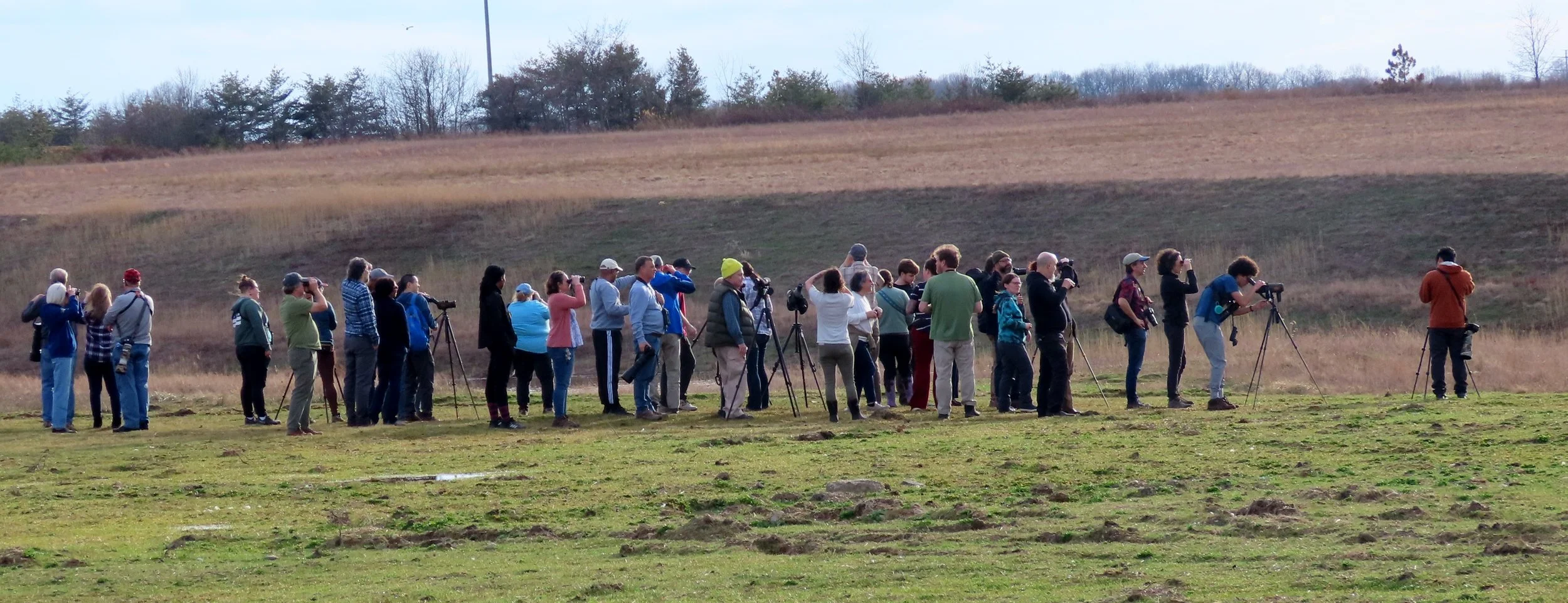
Jay Sheppard leads a Short-eared Owl tour at Konterra. Photo by Linda Vitchock.
We are deeply grateful to Jay for sharing his knowledge and enthusiasm for Short-eared Owls with so many people, to Gould Family Enterprises for its generous matching support, and to Linda Vitchock and Joe Jehl for their additional support. Finally, thank you to everyone who has donated to this project so far.
Your support will help us follow these birds beyond the fields where we first see them. Combined with the measurements, samples, photographs, and capture methods already part of this work, those movement data will help us build a fuller picture of what it will take to conserve a species that depends on a patchwork of open habitats spanning state and national borders.
Learn More and Support the Work
Watch Breakthrough Research: Capturing Wintering Short-eared Owls in Maryland for a closer look at how we developed our capture methods and where this work is headed.
To stay informed about MBCP’s work with Short-eared Owls, sign up for email updates at marylandbirds.org/updates.
If you would like to support the next phase of this work, visit the Where’s Shorty Now? donation page.
References
Booms, T. L., Parrett, L. S., & Keech, M. A. (2012). Use of a net gun to safely capture Short-eared Owls in mid-flight from a helicopter. Journal of Raptor Research, 46(2), 208–211. https://doi.org/10.3356/JRR-11-43.1
Calladine, J. (2024, April 1). Travel wide, breed hard and die young. British Ornithologists’ Union. https://bou.org.uk/blog-calladine-short-eared-owls/
Calladine, J., Hallgrimsson, G. T., Morrison, N., Southall, C., Gunnarsson, H., Jubete, F., Sergio, F., & Mougeot, F. (2024). Remote tracking unveils intercontinental movements of nomadic Short-eared Owls (Asio flammeus) with implications for resource tracking by irruptive specialist predators. Ibis, 166(3), 896–908. https://doi.org/10.1111/ibi.13304
Johnson, J. A., Booms, T. L., DeCicco, L. H., & Douglas, D. C. (2017). Seasonal movements of the Short-eared Owl (Asio flammeus) in western North America as revealed by satellite telemetry. Journal of Raptor Research, 51(2), 115–128. https://doi.org/10.3356/JRR-15-81.1
Banner image: Short-eared Owl by Jonathan Irons.