Maryland Bird Campus Launches Horseshoe Crab Project
When asked if I’d like to cover this story for Maryland Bird Conservation Partnership, I had no idea I’d be joining a rising tide of horseshoe crab fans. I was skeptical that going out in the middle of the night to drill holes into the shell of a strange-looking animal that bleeds blue blood would sell science and nature conservation to young people.
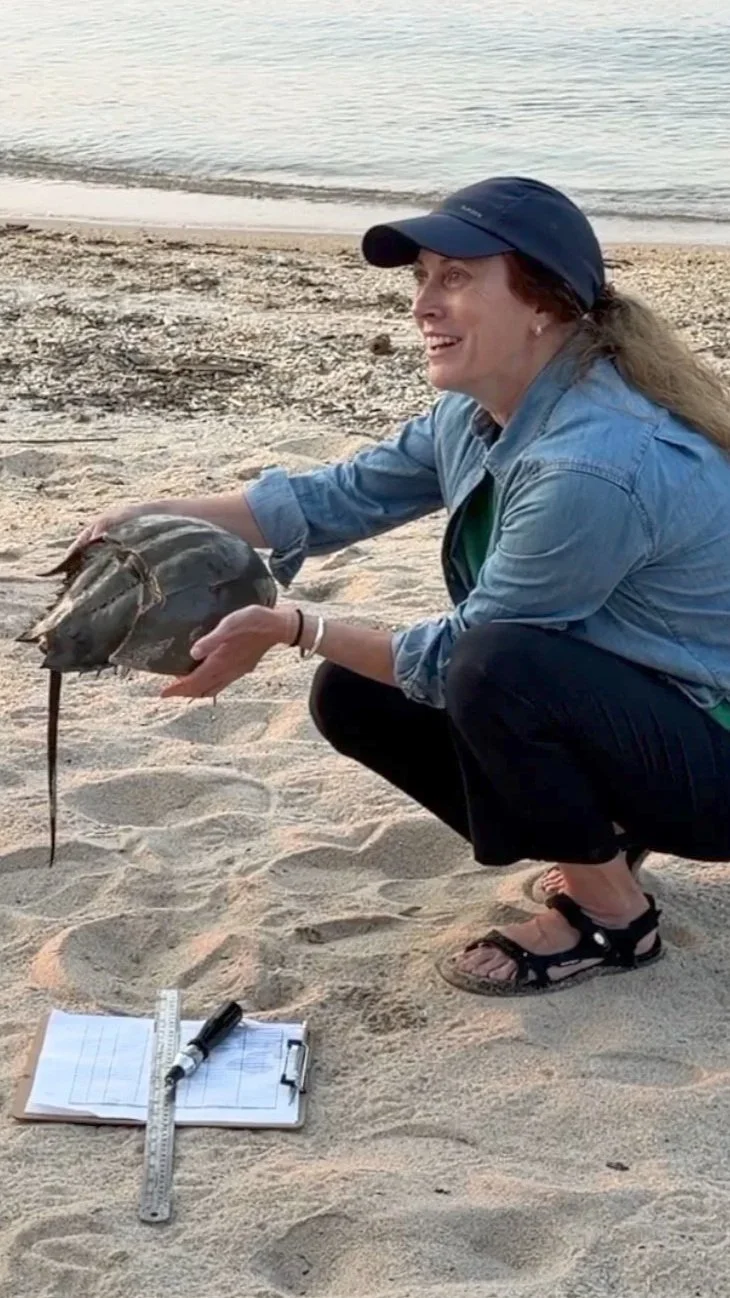
Dr. Tracey Stuller demonstrates how to tag a horseshoe crab at North Beach, Maryland
This spring, the College of Southern Maryland (CSM) launched a horseshoe crab tagging project in Southern Maryland. CSM is the first “Bird Campus”—a status conferred through Bird City Maryland, a program of Maryland Bird Conservation Partnership. The horseshoe crab project is led by Dr. Tracey Stuller, professor of biology, Bird Campus project leader, and recently appointed Endowed Faculty for Innovation, in recognition of “connecting students to real-world science through environmental and community partnerships.”
College of Southern Maryland is the first Maryland Bird Campus and the first Bird Campus in the entire Bird City network.
“I want students to love biology, and these are the types of things that get them to love biology,” said Dr. Stuller. “I think the students love being able to get out and get their hands on something. They learn about tagging, and they also get to have interactions with one another.”
In 2023, Dr. Stuller organized the first annual field trip for faculty and students to New Jersey’s Delaware Bayshore, to tag horseshoe crabs at events organized by the American Littoral Society. The field trip serves as the lab portion of an online Zoology course she teaches. I accepted her invitation to join the CSM group in Cape May this past spring.
When I arrived in the dark at Thompson’s beach on the Delaware Bayshore, I squeezed into one of the last parking spots on the side of the dirt road, and soon there was a traffic jam of cars lined up, headlights blaring. A large crowd of excited people that even included toddlers had already gathered. The event organizer, Shane Godshall of the American Littoral Society, said it was the largest turnout he had seen.
“They’re crashing the party. And can you blame them?” Dr. Stuller said. “I mean, nothing cuter than a horseshoe crab with their little face only a mother could love.”
Watch this video and witness the spawning of horseshoe crabs under a full moon. The College of Southern Maryland made a field trip to the Delaware Bayshore in New Jersey for a tagging event hosted by the American Littoral Society.
Touching Real Live Horseshoe Crabs
On the beach, the crowd separated into small teams and Godshall provided each team with a bag of 25 tags, a clipboard with datasheet and pencil, and a special hand drill. He demonstrated how to identify the crab’s gender (the males have a structure like a boxing glove at the end of a front pair of legs that they use to grab onto the females). Also, he showed volunteers how to handle the crabs with care as they drilled a hole into the first layer of the shell (called the carapace) and attached a round white tag with a unique number.
I encountered a student enthusiastically searching the shoreline waves for the next horseshoe crab to tag. Brianna Whitt told me she doesn’t like science very much, but she really wanted to participate in this interactive field work. Whitt summed it up perfectly when I asked what she knew about the connection between horseshoe crabs and birds: “The horseshoe crabs come up on the shore to mate, and the female horseshoe crab lays eggs, and the birds feast on the eggs.”

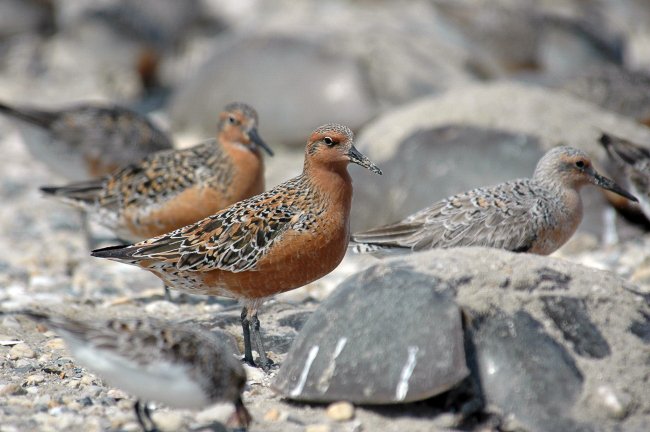
Red knots feed on horseshoe crab eggs along the shore in May at Mispillion Harbor, Delaware. Photo by Gregory Breese/USFWS.
I also met Marlon Charles, a student majoring in art and music. It was his second time on this field trip.
“I like coming here,” Charles said. “I feel like people don’t really appreciate marine life until they actually see it.”
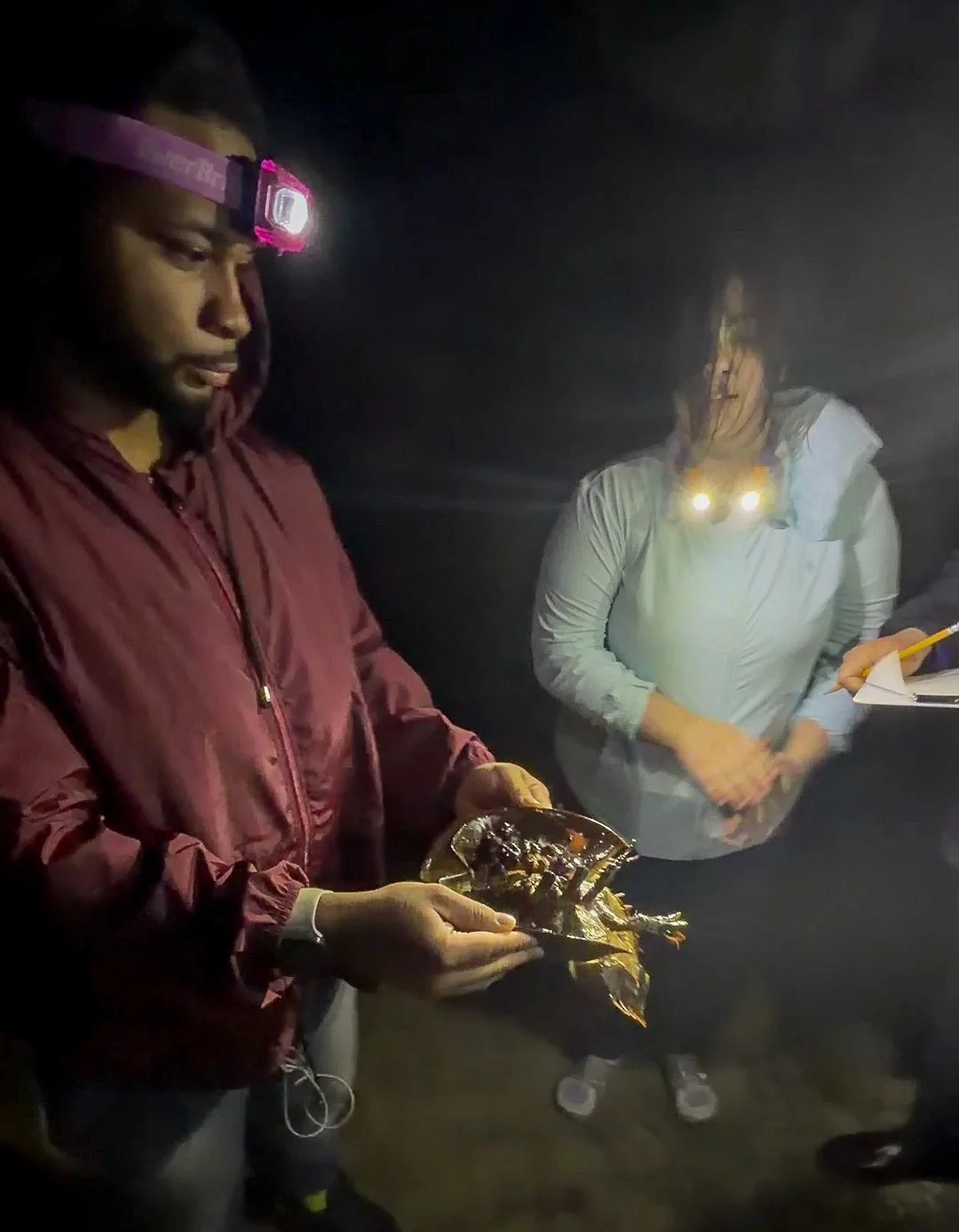
Marlon Charles and Brianna Whitt, College of Southern Maryland students, participated in the horseshoe crab tagging field trip to New Jersey’s Delaware Bayshore in May.
I had to admit, my first contact with horseshoe crabs didn’t leave a favorable impression. Out birding on the Delaware shoreline, I came upon a mucky beach littered with horseshoe crab carcasses, and a lot of flies.
Godshall described the public-relations problem best: “They’re weird looking, they smell bad when they die on the beach, and they make the beach less usable for a couple months.”
But after a night on the beach with the live horseshoe crabs, I concluded that Marlon Charles is right. Being present to spawning horseshoe crabs changes one’s perspective about them. Under a full moon with the waves rolling up to the high tide mark, the horseshoe crabs started coming out of the water by the hundreds, crawling up and over each other, onto the beach. The female crab lays her eggs in the sand, as far up the beach as possible, the male follows behind to fertilize the eggs with his sperm. The water recedes and over the next two weeks, the beach heats up and incubates the eggs. Two weeks later, at the next full or new moon, the juveniles are washed into the bay.
Horseshoe crabs become practically fully formed inside the 3 mm to 3.7 mm egg within less than two weeks. When they hatch the only obvious thing missing is the tail. They continue to grow and molt for 10 years, at which point they have a terminal molt and are sexually mature. They live and breed for another 10 years. Video by Dr. Sook Chang, courtesy of Maryland DNR.
“I love seeing students get over their phobia of these animals,” said Dr. Stuller. “Students are surprised to learn that they can’t hurt you. They’re really quite gentle.”
I felt the horseshoe crabs nudging against my rubber boots as they climbed the beach. With each almost tickle, my affection for them grew.
Horseshoe Crabs, Shorebirds, and Conservation
According to Godshall, it was not the sight of horseshoe crabs being scooped off the beach in front-loaders that started to alarm people. It was the impact on bird populations—the Red Knot in particular—that finally initiated state-level conservation measures. Both Red Knot and horseshoe crab populations are monitored and states cooperate to set and manage horseshoe crab harvest quotas based on the data.
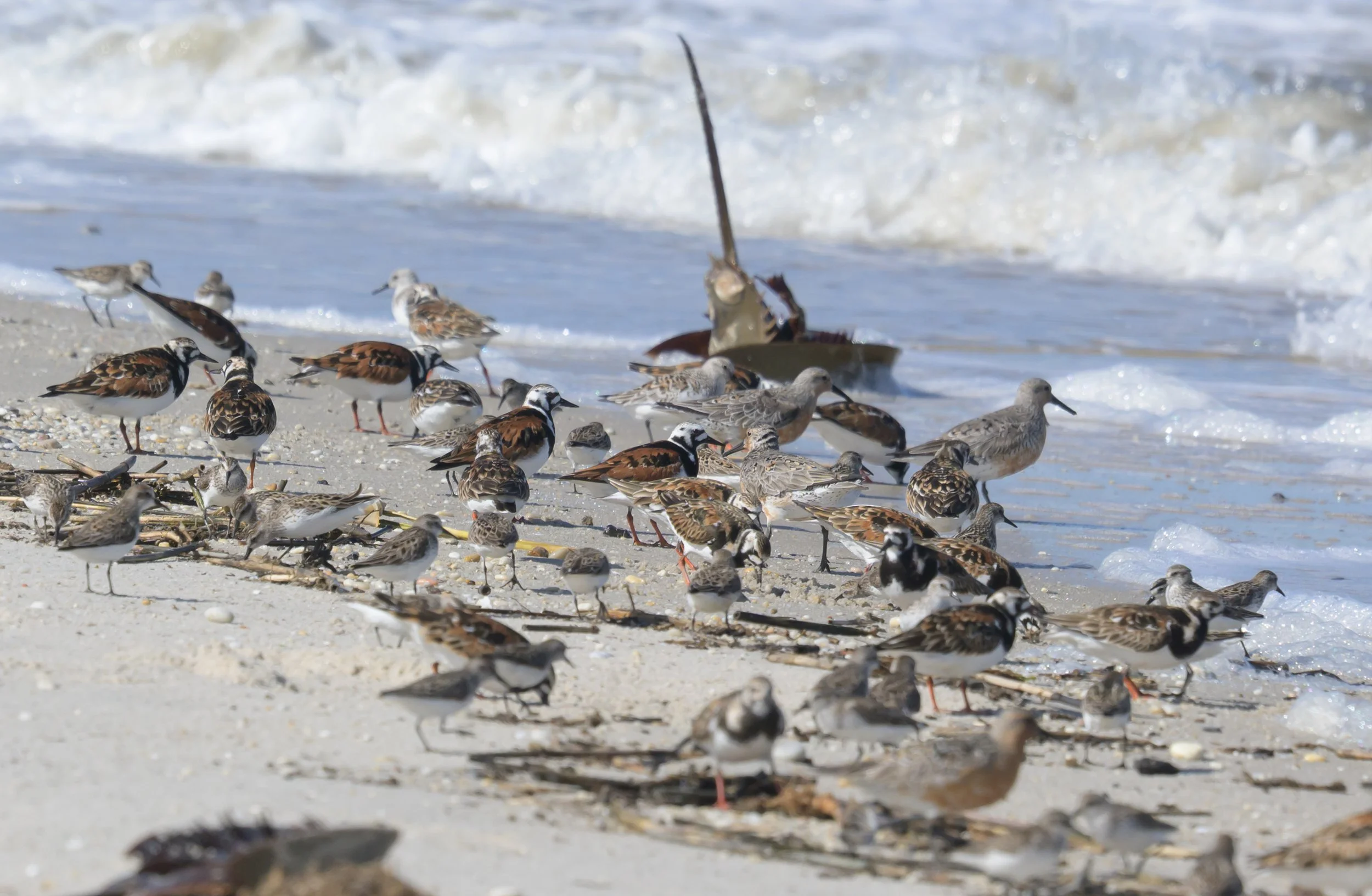
Migrating Red Knots, Ruddy Turnstones, and Semipalmated Sandpipers foraging on a beach near Cape May, New Jersey.
The Red Knot and other shorebirds time their migration journey to coincide with the peak of horseshoe crab spawning season along the Atlantic Coast. They feed on the horseshoe crab eggs and build up energy stores for the last leg of their journey to their breeding grounds in the Arctic. Overharvesting of horseshoe crabs caused dramatic declines in Red Knot populations and led to the listing of the rufa Red Knot as federally threatened in 2014.[1]
Over the centuries, horseshoe crabs have been harvested for fertilizer (colonists learned this use from Native Americans), bait, and, most recently, biomedical purposes. Horseshoe crab blood contains immune cells that coagulate around bacteria, protecting the horseshoe crab from infection, and also making it valuable in the pharmaceutical industry to test for contamination, for example, in vaccines and medical implants.
CSM’s Zoology course covers the taxonomy of horseshoe crabs. As arthropods, they’re more closely related to arachnids—think spiders, ticks, and scorpions—than to crabs. The course also discusses the interconnectivity of food webs in animal life.
“This is a great way for us to show the students: start affecting the population of one keystone species [the horseshoe crab] and there's a cascade effect,” said Dr. Stuller. “We’re seeing that with the migratory birds.”
Respect for Horseshoe Crabs
Turns out that horseshoe crabs have their own cachet, independent of the shorebirds.
North Beach, Maryland, is a town known for their spring Osprey festival, and they take great pride in their horseshoe crabs too. The crabs spawn on the beach but unfortunately get caught on the riprap along the coastline. Many dedicated townspeople rescue the crabs that get stuck.
At the end of June, the town hosted the first public horseshoe crab tagging event sponsored in partnership with CSM. There were nearly 20 people there, including CSM faculty and students. Many attendees had seen the event advertised on the Southern Maryland Audubon Society’s Facebook page.
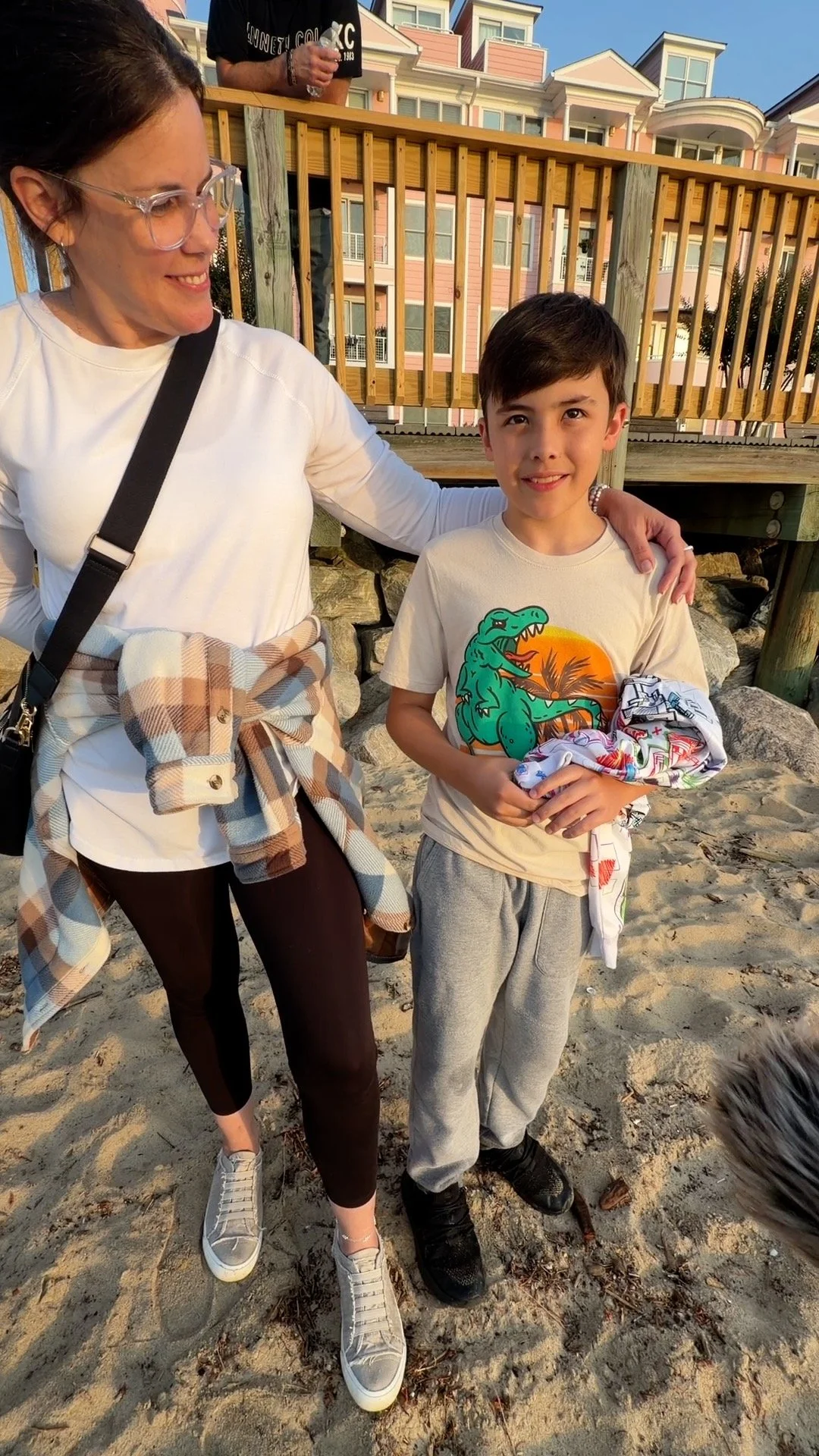
Crystal and her son Caden Martinez got up early to go to the North Beach horseshoe crab tagging event to see “these historic, marvelous animals.”
Crystal Martinez told me she brought her son Caden down from Dunkirk “to see these historic, marvelous animals, learn more about them, and see how they are being saved.” Caden confessed that he did not appreciate being woken up so early, but he was glad he saw the “amazing” animals.
“They’ve kind of been around for millions and millions of years [about 450 million years]. They didn’t go extinct like dinosaurs. Their species kept on living,” he said. I told Caden that learning that horseshoe crabs survived five mass extinction events in Earth’s history endeared them to me, too.
At the beach, the town has put up signs to keep people out of the spawning area. Mary Healey, one of the town councilmembers attending the event, stopped to chat with me.
“When the horseshoe crabs first start spawning, I always come out and do my traditional video with Marvin Gaye’s music “Let’s Get It On” in the background. There’s a lot of sex on the beach,” she said. “We’re all here this morning just getting a little more education on why we tag, where our horseshoe’s spawn, and how we’re going to track this in the future.”
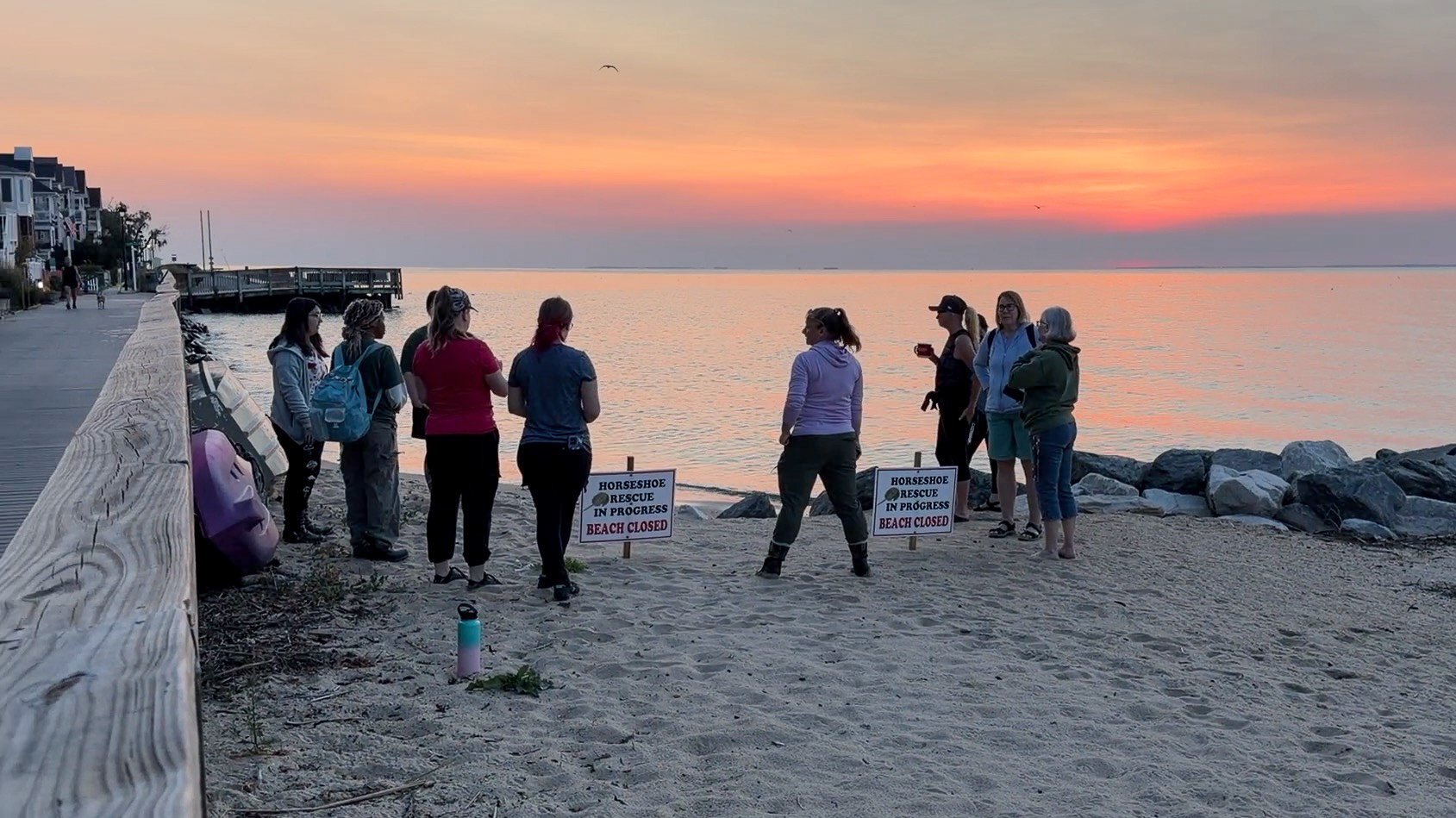
Signage installed by the Town of North Beach warns beachgoers to stay out of the horseshoe crab spawning area. Volunteers gather for the town’s first horseshoe tagging event, hosted in partnership with CSM.

You Can Help horseshoe crabs
Report recovered tags online at fws.gov/crabtag
Photo credit: Horseshoe crab with tag by Nathan Daetwyler
Dr. Stuller explained to the group that tagging provides information about site fidelity—are the horseshoe crabs coming back to the same site or the same beaches to breed and lay eggs? Of course, that information is only possible if people who find tags report where they found them.
Since the U.S. Fish and Wildlife Service (USFWS) Cooperative Horseshoe Tagging Program began in 1999, more than 472,000 tags have been used and 62,000 unique tags have been recovered, according to Mike Mangold, Project Leader of the Maryland Fish & Wildlife Conservation Office, which oversees the tagging program. Learning about site fidelity and horseshoe crab movement is the reason the program was started in 1999, but today the tagging program is as much about public education and outreach as it is about science.

USFWS Cooperative Horseshoe Crab Tagging Program certificate of participation. Photo courtesy of Chris Flood.
“We love your program!”
“We love looking for the tagged horseshoe crabs on the beach and learning more about it!”
Those are the kinds of comments that Mangold receives from the public. When a recovered tag is reported through the online portal, his office issues to the finder a certificate that shows where the tag originated, and a pewter horseshoe crab pin for the first reported tag.
CSM’s Horseshoe Crab Tagging Project
“As an instructor in community college in the biology faculty, I’m always looking for cool ways to engage students in citizen science.” Dr. Stuller told me. “It's just really neat how that all came together, and is making a connection with our Bird Campus status.”
CSM has been recognized as a Bird Campus for five years and was the first Bird Campus, not only in Maryland but in the entire Bird City Network. CSM also obtained “High Flyer” standing by scoring double the required minimum action points on their application.
Watch a video about CSM’s participation in USFWS’s Cooperative Hourshoe Crab Tagging Program.
“Teaching students through community science is the kind of action that a Bird Campus is uniquely positioned to do and fits perfectly with this year’s theme for World Migratory Bird Day—'Every Bird Counts – Your Observations Matter,’” noted Pamela Kellett, coordinator of MBCP’s Maryland Bird City program.
I’m not surprised that Dr. Stuller went for the “High Flyer” Bird Campus status in CSM’s application. She is clearly devoted to making education as fulfilling and rewarding as possible for her students. This undoubtedly comes from her own education journey. She didn’t even have college in mind when she was in high school, but ultimately became a veterinarian.
Dr. Stuller sought out her own high-impact experiences with animals to beef up her application to graduate school, which explains in part why she is so enthusiastic about providing hands-on experiences for her students. She worked at a horse farm mucking stalls, cared for injured, orphaned wildlife at a wildlife rehabilitation center, worked for an exotic animal vet, and banded Ospreys somewhere along the way. Dr. Stuller practiced small animal medicine for several years. Her teaching career began in earnest in 2011.
Dr. Stuller applied to the Maryland Department of Natural Resources (DNR) for a scientific collection permit. She received the permit and the 500 tags just in time for horseshoe crab spawning season and immediately trained the naturalists at North Beach and at Flag Ponds how to tag.
“We thought it was a great opportunity, since people are already getting their hands on the crabs.” North Beach naturalist Paige Stevens said. “We run interception: they’re rescuing, we’re putting a tag on before they put them back in the water.”
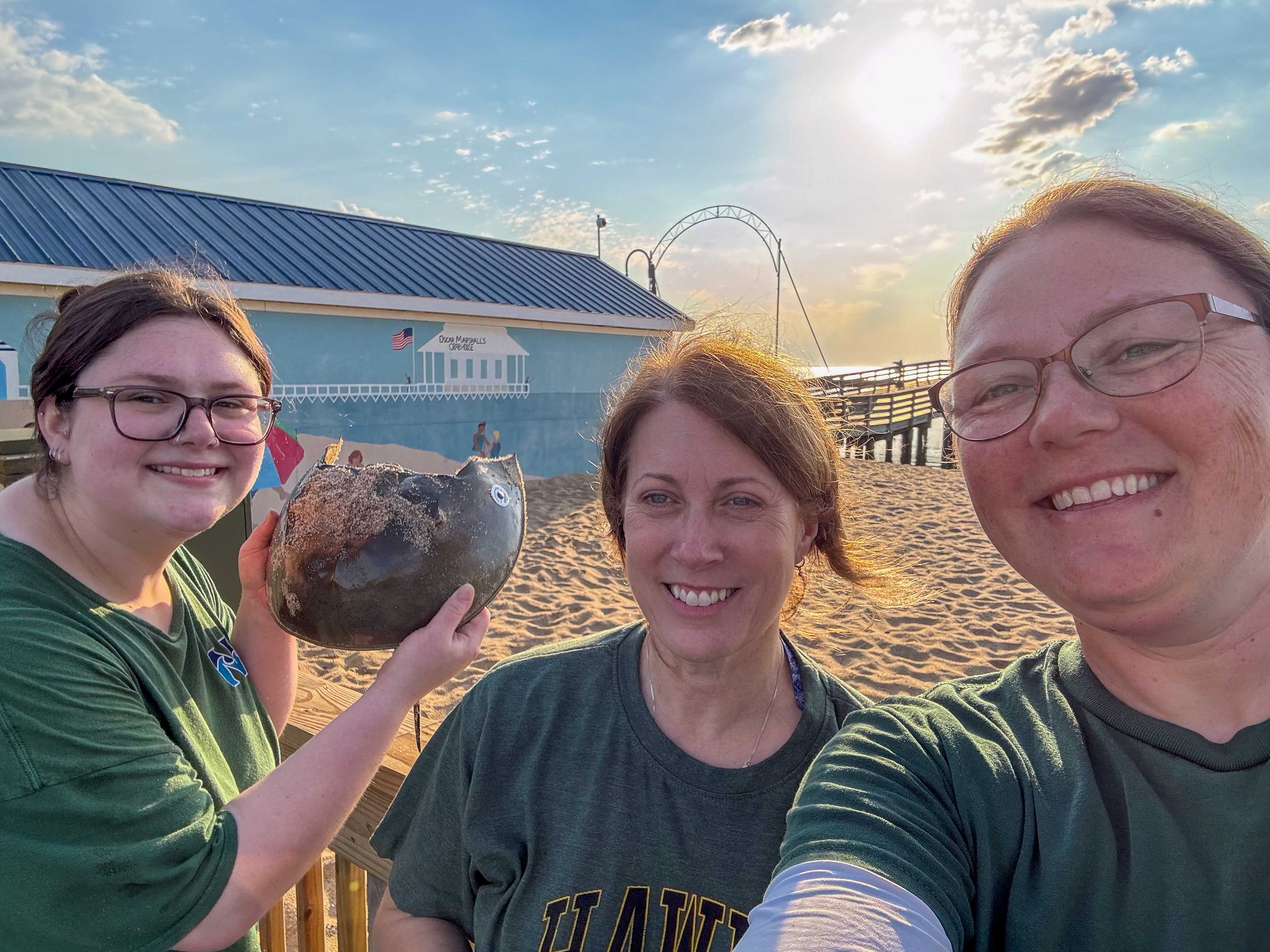
Dr. Tracey Stuller (middle) with Town of North Beach naturalist Paige Stevens (left) and Calvert County naturalist Kim Curren (right). The three work closely together to maximize the opportunities for horseshoe crab tagging on the Southern Maryland Chesapeake Bay shoreline.
“Each of the individual tagging cooperators submits their data, and then USFWS sends a report back to them about the tags that were recovered by the public,” Mangold said. That data, as well as information about the origin of any tags that they’ve found when tagging, can be used to learn more about the movement of the horseshoe crab population in their areas. Mangold said there hasn’t been much horseshoe crab tagging in the Chesapeake Bay.
CSM received a grant from Cove Point Heritage Trust to purchase equipment and fund student internships.
Only a couple months into the project, Dr. Stuller says she’s pleased with the connections she’s made and people that have “come out of the woodwork” that she wasn’t expecting.
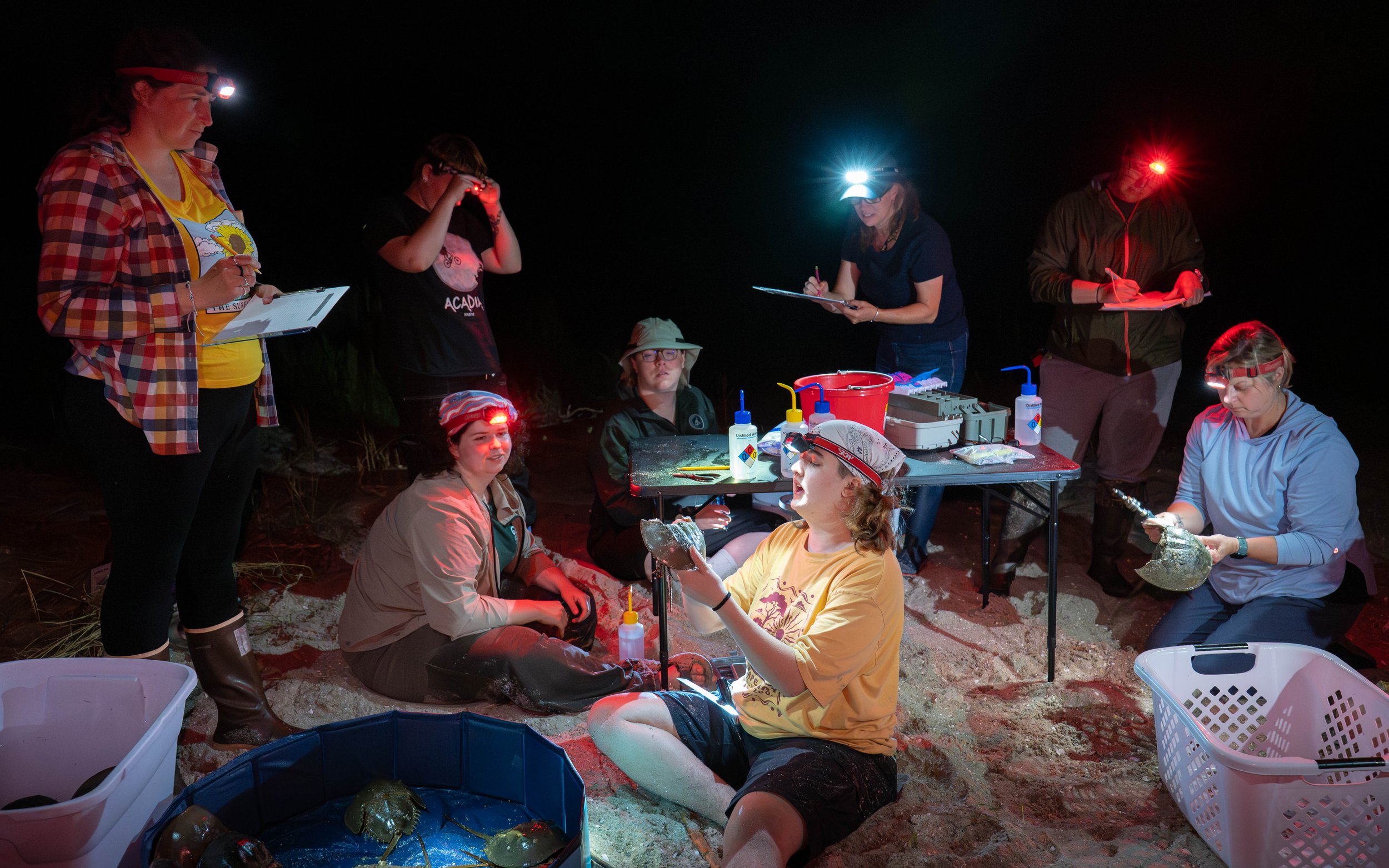
Horseshoe crab tagging event with CSM students and faculty at Flag Ponds beach. Photo by Nathan Daetwyler.
“I was thinking I would be focusing mostly in North Beach with that volunteer group,” Dr. Stuller mused. “And then lo and behold, there's interest in Flag Ponds. Lo and behold, there's interest in Cove Point. Lo and behold, I know somebody that has a beachfront property and there's interest there. So it's been fun to see how much interest there is around these horseshoe crabs.”
While tagging has been the primary effort, Dr. Stuller has started to gather more data, such as size measurements of the horseshoe crab, and some crude age estimates. She may also organize spawning surveys, but she doesn’t want to get ahead of herself.
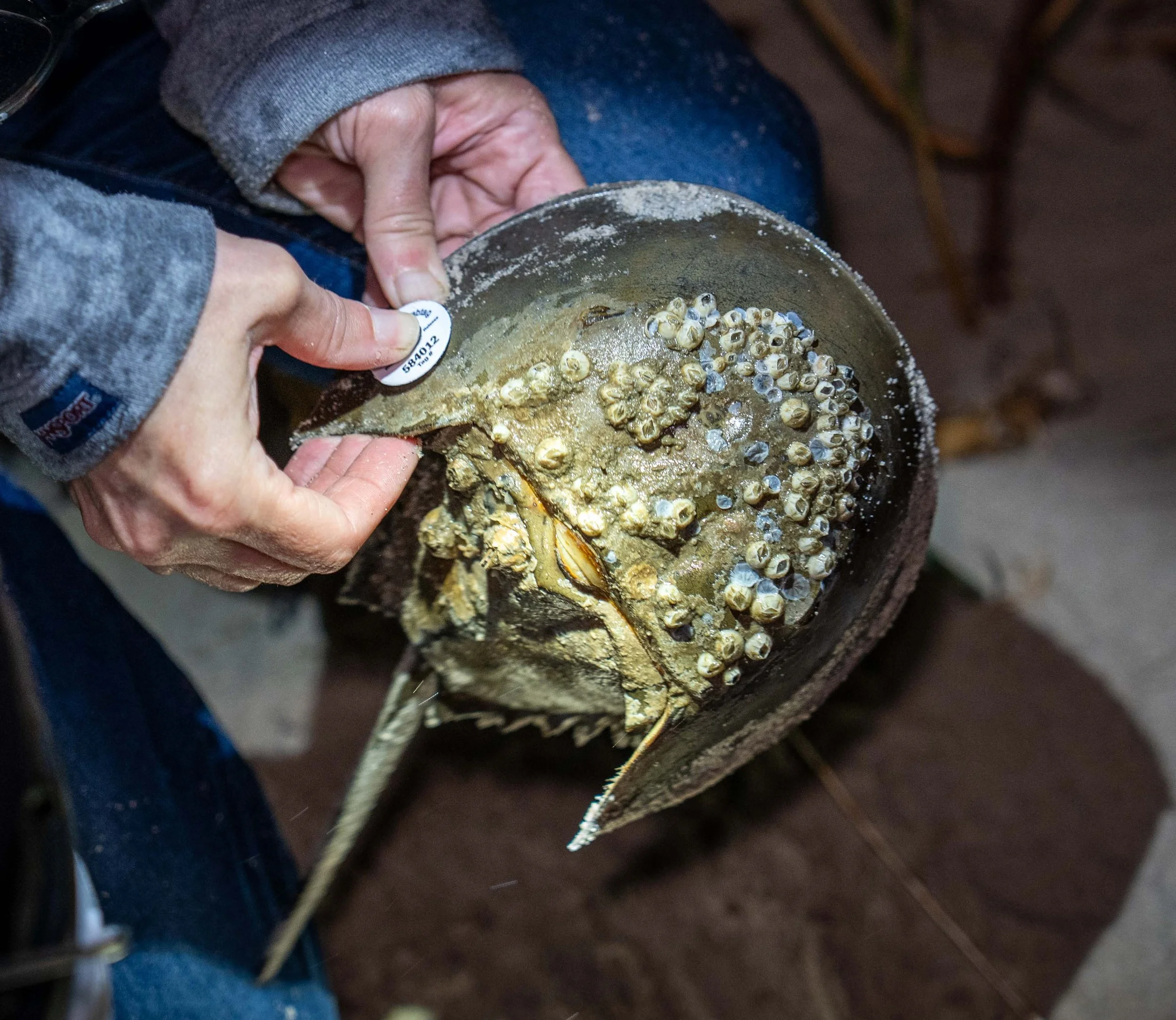
The age of a horseshoe crab can be crudely estimated based on the carapace color (young crabs are a bright olive green), wear (e.g., scratches and chips), and how much epibionts are on the surface. Epibionts are “those little critters like barnacles,” Dr. Stuller explained. Photo by Nathan Daetwyler.
Horseshoe Crabs in the Chesapeake Bay
There are actually four species of horseshoe crab, but the Atlantic Horseshoe Crab (Limulus polyphemus) is the only one in the Western Hemisphere, and it’s the most abundant globally.
In May and June, there are more spawning horseshoe crabs in the Delaware Bay than anywhere else on the planet. But what about in the Chesapeake Bay?
Steve Doctor, a fisheries biologist with the Maryland DNR, manages Maryland’s horseshoe crab spawning surveys. [2] The spawning surveys, which are conducted on the Atlantic coast, are required of all Delaware Bay states by the Atlantic States Marine Fisheries Commission (ASMFC). The surveys document where horseshoe crabs are spawning and the quality of the breeding population in Maryland, but they are not used in the population estimates of horseshoe crabs that are factored into the model for determining horseshoe crab harvest quotas.[3]
Since the surveys are not conducted in the Chesapeake Bay, there’s less information about horseshoe crab spawning there, Doctor said. Yet, over the past five years, he’s been receiving more information and interest from various groups with “boots on the ground” in the Chesapeake Bay area. DNR’s blue crab surveys, which are conducted by trawling in six different river systems, provide clues about horseshoe crab populations as well.
“The data seem to indicate that there is large-scale spawning going on in the Chesapeake Bay, but we don’t know where it is happening,” Doctor said. “Currently we know of fewer than a hundred beaches where they are spawning, but there are plenty of little sand beaches all over the place, even in the marshes.”
Notes
[1] According to the 2025 State of the Birds report, the Red Knot has lost more than 50% of its population in the past 50 years and this downward trajectory has only sped up over the past decade. The 2025 U.S. State of the Birds report was produced by a consortium of scientific and conservation organizations and entities led by North American Bird Conservation Initiative (NABCI).
[2] Steve Doctor is Maryland’s technical representative on ASMFC’s Adaptive Resource Management Technical Committee, which is responsible for determining the impact of horseshoe crab harvest on populations of shorebirds and interaction between horseshoe crabs and shorebirds. According to Doctor, the horseshoe crab harvest quota in Maryland in 2026 is 255,980 males and zero females. Maryland does not allow harvesting off spawning beaches, and nearly zero harvesting is done in the Chesapeake Bay, he said.
[3] The Atlantic States Marine Fisheries Commission conducts the coastal horseshoe crab assessment used in setting harvest quotas. https://asmfc.org/species/horseshoe-crab/
Banner photo: Red knots feed on horseshoe crab eggs along the shore in May at Mispillion Harbor, Delaware. Photo by Gregory Breese/USFWS.